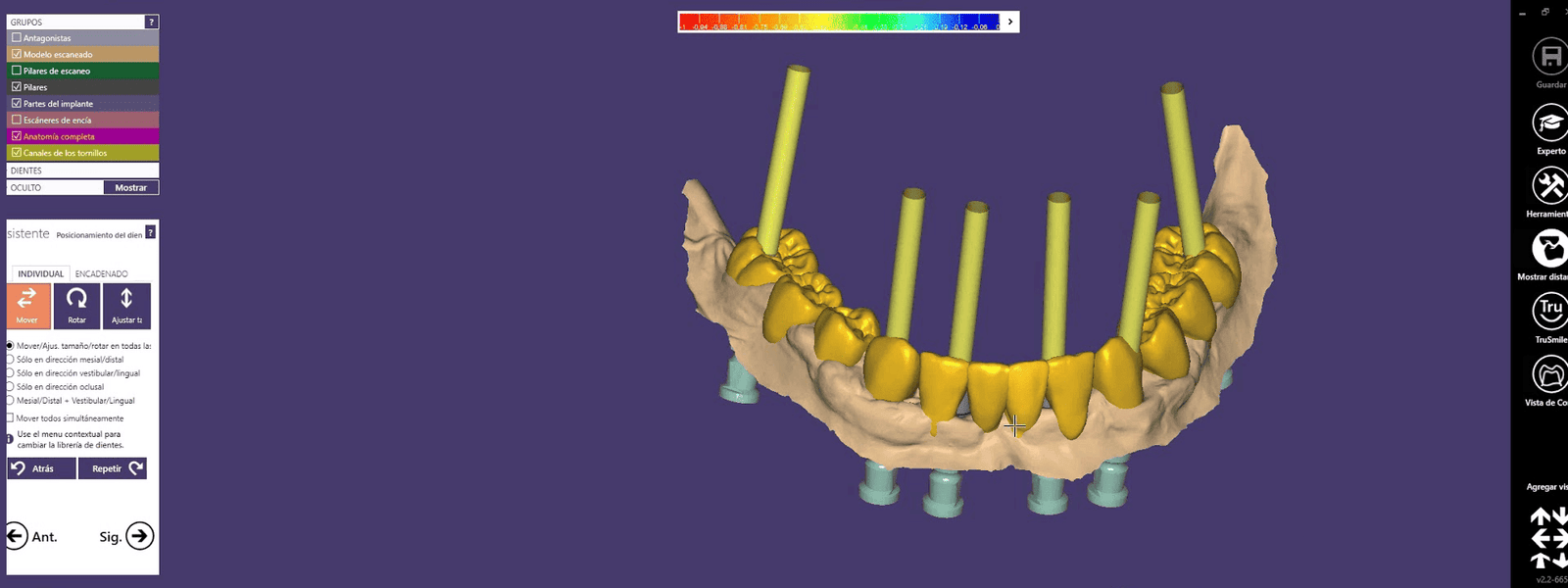
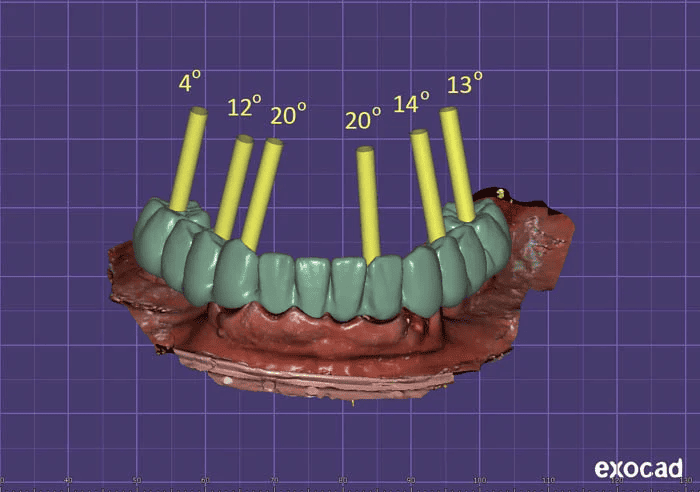
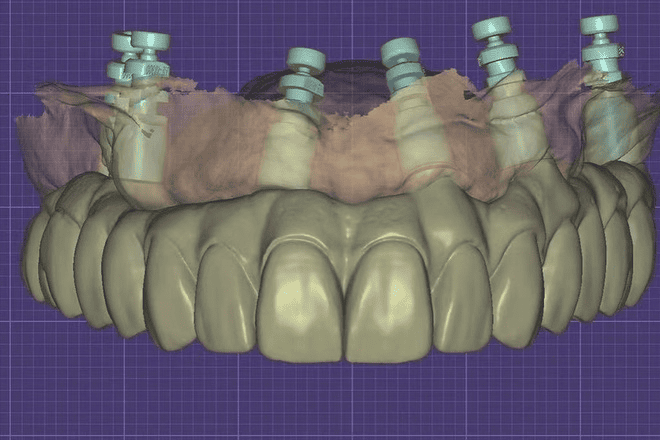
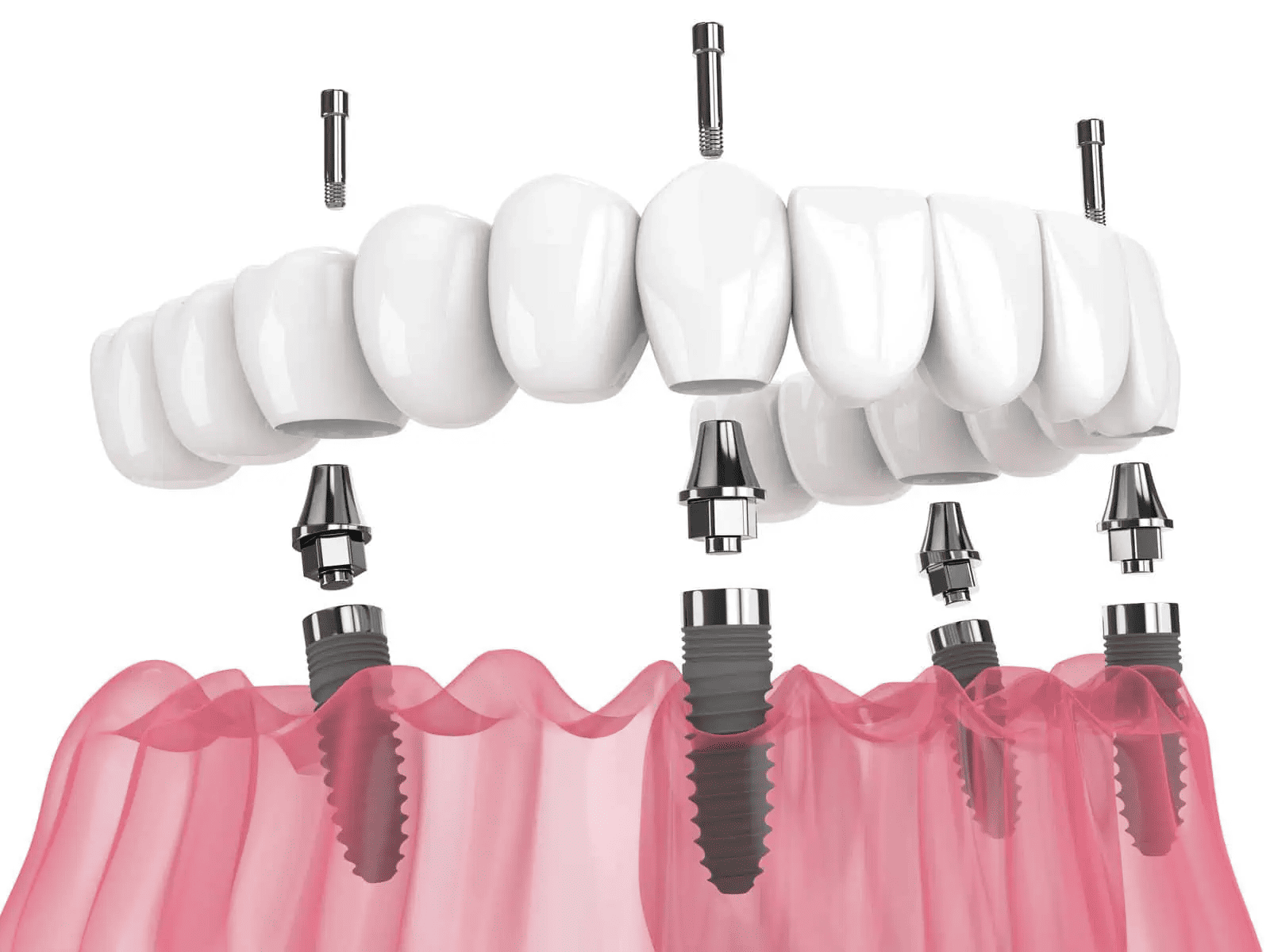
All-on-X & Full-Arch CAD Design Outsourcing
All-on-X & Full-Arch CAD Design does not begin when an STL is opened in Exocad, and it does not end when a file is exported.
By the time CAD starts, many of the most important decisions have already been made—or should have been. Tooth position, vertical dimension, implant position, available restorative space, the intended material, and the way the case will eventually be milled or printed all shape what the designer can realistically do. CAD cannot simply fix upstream conditions that are still unclear or unresolved.
A full-arch case therefore moves through a connected chain:
Restorative Goal → Validated Context → Design Judgment → Review / Approval → Fabrication
Good full-arch design is less about drawing a restoration and more about carrying a restorative plan through that chain. The designer needs to understand what the case is trying to achieve, recognize where the real limits are, make the decisions that belong inside CAD, and know when something needs to go back for confirmation.
The same principle applies to outsourcing. Sending files to an external team is easy. The harder question is whether that team can take responsibility for this part of the workflow without forcing the lab to re-check every case, repeat the same instructions, or repair design problems before fabrication.
A useful full-arch design partner should therefore do more than return a good-looking STL. The real test is whether the team can consistently turn a clear restorative plan into a design that fits the intended fabrication workflow—without the management burden growing along with the case volume.
What Part of the Full-Arch Workflow Should Actually Be Outsourced?
Not every lab needs the same kind of full-arch support. One may simply need more design capacity during busy periods; another may need stronger full-arch design judgment; another may already design well but need help with planning support or downstream fabrication.
The outsourcing scope should follow the capability gap—not the other way around.
Define the Capability Gap Before Choosing a Partner
Start with the bottleneck, not the provider.
If the internal team already handles full-arch cases well but cannot keep up with volume, the need is mainly capacity. If routine CAD is under control but complex implant cases repeatedly require senior designers to step in, the gap is more likely specialist design judgment. If the uncertainty exists before CAD starts, adding another CAD operator may simply move the same unresolved problem to an external team.
A useful first check is:
| What is missing? |
What may actually be needed? |
| Enough designer hours |
Additional CAD design capacity |
| Full-arch case judgment |
Specialist full-arch design support |
| Clear restorative or planning context |
Planning/design coordination before CAD proceeds |
| Downstream fabrication capacity |
Fabrication support rather than more CAD capacity |
| A repeatable handoff process |
Workflow clarification before adding another provider |
This distinction matters because different gaps require different partners. A team that is excellent at producing CAD files does not automatically solve a planning problem, a fabrication bottleneck, or an unclear internal workflow.
Design-Only vs Broader Full-Arch Support
Full-arch work can be divided into separate modules rather than outsourced as one package.
A design-only scope can work well when the restorative goal, implant information, case records, fabrication route, and approval process are already clear. The external team receives a design-ready case, completes the CAD work, and returns files for the next stage.
A broader scope may include planning support + design, or design + fabrication. That can reduce handoffs in some workflows, but only when the added responsibility is clearly defined. Broader scope should not quietly turn design support into clinical decision-making or make it unclear who owns final approval.
More services do not automatically mean a better outsourcing model. The question is whether each added service closes a real gap.
Define Responsibility Before the First Case
Scope is not truly defined until responsibility is clear.
The external design team may be responsible for reviewing whether the supplied data can support design, making CAD decisions within the approved restorative plan, identifying conflicts, and preparing the required design output.
The lab or designated reviewing party still needs to provide case-specific requirements, existing design standards, downstream fabrication requirements, and approval where the workflow requires it. Clinical diagnosis, treatment decisions, implant placement, and other clinical responsibilities remain with the treating clinician.
Some decisions sit between these roles. A change in tooth position may affect restorative space. A screw-access problem may require more than a CAD adjustment. An implant component or library mismatch may stop the case completely. These are not situations where the designer should guess simply to keep the case moving. They need an explicit confirmation path.
When the Full Workflow Should Not Be Outsourced as One Package
There is little value in outsourcing parts of a workflow that already work well internally.
A lab with strong planning and fabrication capability may only need external design capacity. Another may keep design review in-house but use an external team for the first CAD stage. A different workflow may benefit from combining design and fabrication because the two stages are closely linked.
The right model is therefore not automatically “design only” or “full service.” It is the scope that closes the real capability gap while keeping responsibility, review, and control clear.
Decision Rule
Define the capability gap first. Then define the outsourcing scope.
If that first question is skipped, outsourcing can easily add another provider without actually removing the original bottleneck.
What Information Does an External Full-Arch Designer Really Need?
Sending a complete set of files does not always mean the designer has everything needed to make the right decisions.
STL files, implant information, bite records, photographs, and other digital records describe the case. But they do not automatically explain what the restoration is expected to achieve, which decisions have already been made, what can still be changed, or what the downstream fabrication process requires.
Files tell the designer what exists. Context explains what the design is supposed to achieve.
Required Clinical and Digital Records
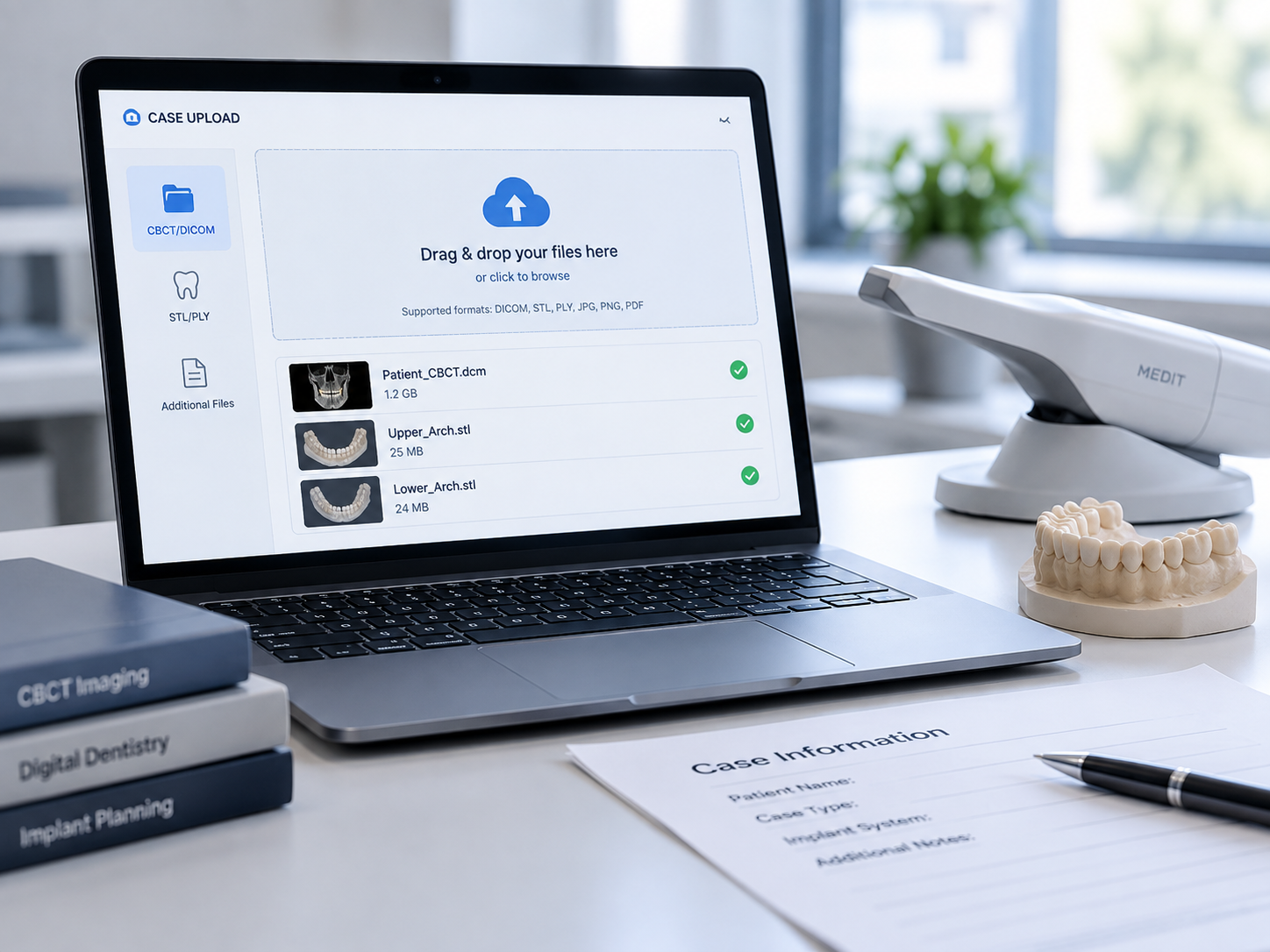
A full-arch case still needs the basic records that allow the designer to understand the current situation: intraoral or model scans, implant or component information, the jaw relationship or bite record, and any additional records required by the specific workflow.
But the important question is not simply whether those files are present.
The question is whether they are usable together.
A scan may be complete but not align correctly with the bite. Implant information may be present but not match the intended component or library. A file may open normally while still leaving uncertainty about tooth position, tissue relationship, or the reference used for the design.
When those relationships are unclear, the designer should not treat “files received” as “case ready.”
Case received ≠ design-ready.
Restorative Goal and Design Intent
A designer also needs to know what the case is trying to achieve.
That may include the intended tooth position, occlusal relationship, esthetic direction, restorative space, or any approved reference that should guide the final design. In some workflows, a provisional, wax-up, existing denture, previous design, or approved setup may already carry part of that intent.
This matters because CAD should not invent the restorative goal from the available geometry.
Two designers can receive exactly the same STL files and still produce very different results if one understands the intended restorative outcome and the other is simply trying to make the geometry “work.”
Good full-arch design starts from the intended result, not from whatever the software happens to make possible.
Clinical and Restorative Constraints
Some conditions are fixed before design begins. Others may still be adjustable.
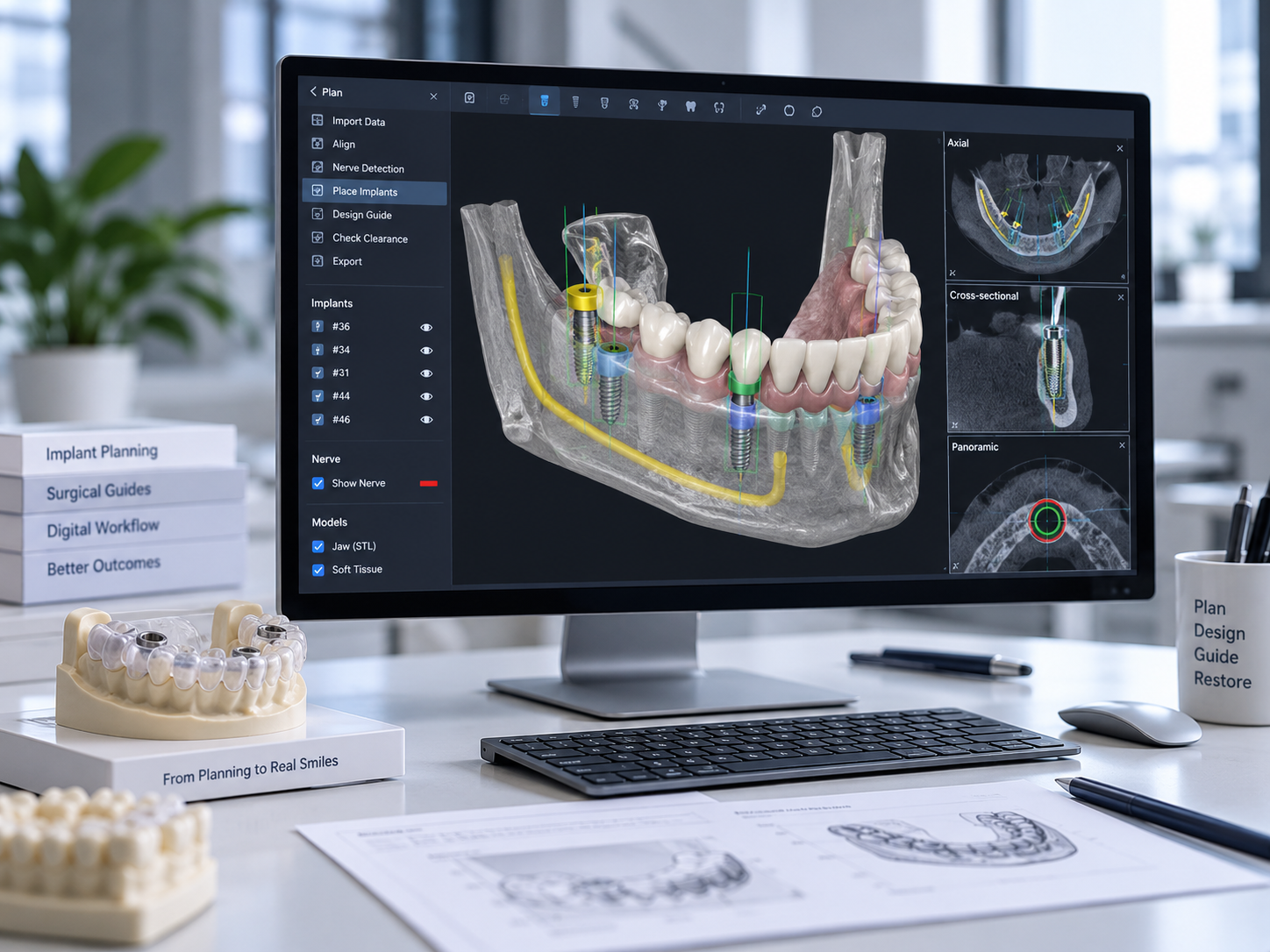
Implant position, available restorative space, tissue anatomy, vertical dimension, tooth position, screw-access direction, and component selection can all affect what is realistically possible inside CAD.
The external designer needs to understand which of these conditions are already approved, which are design variables, and which require confirmation if a conflict appears.
That distinction prevents an important failure mode: solving the wrong problem inside CAD.
If the available space conflicts with the intended tooth position, or the screw-access path conflicts with the restorative plan, the correct response may not be “adjust the design until it fits.” It may be to stop and clarify which requirement has priority.
Fabrication Context
The design also needs to know where it is going next.
Material choice, milling or printing route, implant components, libraries, machine or process limitations, and the expected output all influence design decisions before the file is exported.
A design that looks correct on screen may still create problems if it ignores how the restoration will actually be fabricated.
That is why fabrication information should not be treated as something added after design is complete. The intended fabrication workflow is part of the design context from the beginning.
Lab-Specific Preferences and Existing Standards
Long-term outsourcing also depends on information that may never appear in the STL.
Different labs can have different preferences for contacts, occlusion, tissue contour, emergence, hygiene access, tooth position, naming, file organization, review points, and how much freedom the external designer should have before asking for approval.
These preferences matter because they determine whether the returned design fits naturally into the lab’s existing workflow or creates another round of internal correction.
The goal is not to give the designer more instructions forever. It is to turn repeated preferences into repeatable design rules so that routine cases become easier to hand off while unusual cases still receive the right questions.
A case is truly design-ready when the external team understands not only what files were sent, but also what the case is trying to achieve, what cannot be changed, what still requires judgment, and how the final design will be fabricated.
How to Tell Design Judgment from CAD Execution
Two teams can use the same software, receive the same files, and still produce very different full-arch designs.
The difference is often not software skill. It is how the designer reads the case, understands the restorative goal, and responds when several constraints cannot all be satisfied at the same time.
CAD execution is about operating the tools. Design judgment is about deciding what the design should do, what can be changed, what should not be changed, and when the case needs clarification instead of another adjustment.
The Restorative Goal Sets the Direction
A full-arch design should not begin by asking what shape can be created from the current scan.
It should begin with a clearer question:
What is this restoration supposed to achieve?
Tooth position, smile line, vertical dimension, occlusal relationship, function, phonetics, and the intended prosthetic setup all influence the direction of the design. Once that direction is clear, CAD becomes the process of working toward it within the limits of the actual case.
This is why two designs that both look technically acceptable on screen may not be equally appropriate. One may follow the intended restorative outcome; the other may simply fit the available geometry.
Existing Conditions Set the Design Boundaries
The restorative goal gives the direction, but the existing case determines how much freedom the designer actually has.
Implant position, screw-access direction, restorative space, tissue anatomy, component dimensions, material thickness, and the fabrication route can all limit what is possible.
These factors do not exist independently.
Moving a tooth may improve esthetics but reduce restorative space. Adjusting contour may improve emergence but create hygiene problems. Changing occlusion may solve one contact issue while creating another. A screw-access correction may affect tooth position or require a different restorative solution.
This is where design stops being a checklist.
The real work is understanding how one decision changes the others.
Good Design Is a Balance Between Constraints
Experienced full-arch design is rarely about maximizing one variable.
The objective is to find a workable balance between the restorative goal and the limitations of the case.
That may mean balancing:
- tooth position against implant and screw-access position;
- esthetics against restorative space and material thickness;
- tissue adaptation against hygiene access;
- occlusion against available geometry;
- ideal contour against what the chosen fabrication process can actually reproduce.
The “best-looking” option in one view may not be the most reliable design overall.
For an outsourcing partner, this matters because a team can know every technical parameter and still make poor decisions when those parameters begin to compete with each other.
Different Cases Should Produce Different Design Responses
One of the clearest signs of real design judgment is that the same preset is not applied to every case.
A case with favorable implant position and generous restorative space may allow a straightforward solution. A case with limited space, unfavorable angulation, tissue discrepancies, or conflicting esthetic and mechanical demands should produce a different response.
Sometimes the right response is a design adjustment. Sometimes it is a different component, material, or fabrication strategy. And sometimes the case should stop for confirmation.
This is where two design providers can respond very differently to the same case. One may keep adjusting the geometry until the design appears workable. Another may recognize that the real conflict sits between tooth position, screw access, restorative space, or fabrication requirements—and clarify which constraint should take priority before continuing.
The difference is not whether both teams can complete the CAD. It is whether they can recognize when completing the CAD would mean solving the wrong problem.
In complex full-arch cases, knowing when to adjust, when to change strategy, and when to stop and ask is part of design judgment.
Decision Rule
A checklist shows what a team knows. Case-dependent decisions show how the team thinks.
When comparing external full-arch design teams, do not judge them only by how clean the first file looks or how quickly the CAD is completed.
Compare how each team handles the same uncertainty. Can they distinguish between something that can be adjusted inside CAD and a constraint that needs confirmation? Can they explain the trade-off when tooth position, screw access, restorative space, material, or fabrication requirements conflict? And do they know when continuing the design would create more risk than stopping to clarify?
That response tells you more about design judgment than the appearance of a single finished file.
When Is a Full-Arch Design Ready to Move Into Fabrication?
A full-arch design is not ready for fabrication simply because the CAD work is finished.
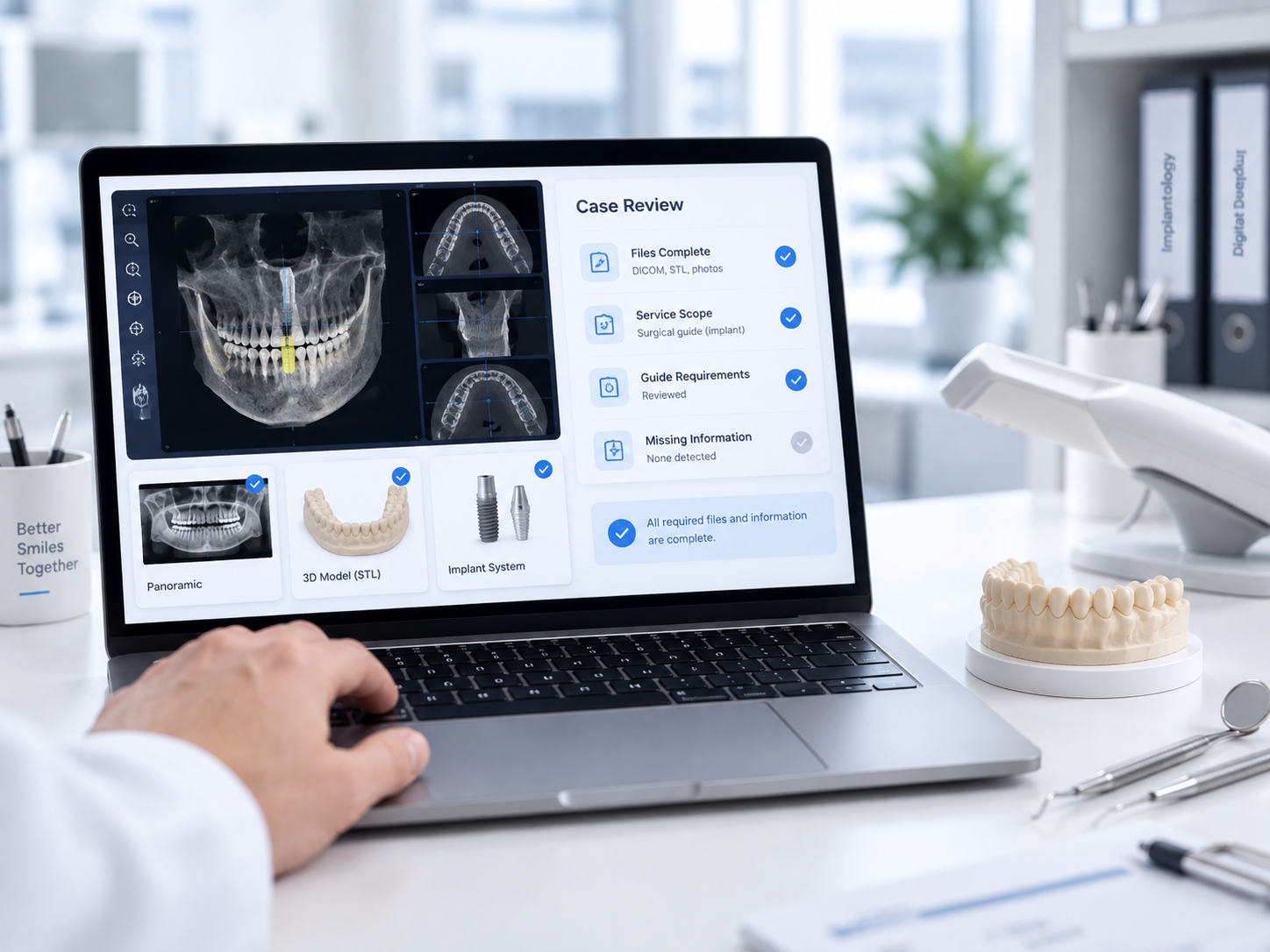
The important question is whether the design has passed the checks, decisions, and approvals needed for the next stage to proceed without creating avoidable problems.
Design completed ≠ fabrication-ready.
Review the Decisions That Matter Before Approval
Not every detail carries the same risk.
Before release, the review should focus on the decisions that can materially affect the restoration or the downstream workflow: tooth position, occlusion, screw access, restorative space, tissue relationship, component compatibility, material requirements, and any case-specific instructions that could change the final outcome.
The goal is not to review every case as if nothing can be trusted.
The goal is to make sure that the decisions with real downstream consequences have actually been checked.
A strong review process therefore becomes more selective over time. Routine preferences can become standard rules. High-impact or unusual conditions should still receive explicit attention.
Know When to Stop and Confirm
Some design problems can be solved inside CAD. Others should stop the case.
If the restorative goal conflicts with available space, the screw-access position creates a major compromise, the component information does not match, or the intended fabrication route cannot support the current design, the designer should not simply continue until the file looks acceptable.
At that point, the issue is no longer “how should the CAD be adjusted?”
It becomes:
What needs to be confirmed before the design can safely move forward?
This is one of the most important differences between a reliable design workflow and a fast but uncontrolled one.
Stopping at the right time is part of good design.
Check the Design Against the Intended Fabrication Workflow
A design can look correct on screen and still fail downstream.
Before release, the file needs to make sense for the actual fabrication route: the intended material, milling or printing process, implant components, libraries, minimum thickness, connection geometry, and output requirements.
The exact checks will vary from one workflow to another, but the principle stays the same:
Fabrication-ready always means ready for the defined downstream workflow—not universally ready for any machine, material, or provider.
This is why fabrication requirements belong inside the design process, not after it.
Revision Should Resolve a Cause, Not Restart the Case
Revisions are normal in complex full-arch work. Repeating the same uncertainty is not.
When a revision is requested, the first useful question is:
What actually caused the change?
Was the original information incomplete?
Did a case instruction change?
Was a lab preference misunderstood?
Did the designer interpret the case incorrectly?
Did the fabrication requirement change?
That difference matters because each cause should lead to a different response.
A useful revision fixes a defined problem and makes the next step clearer. A weak revision process simply starts another guessing cycle.
Over time, recurring revision causes should also become feedback for the workflow. If the same issue keeps returning, the solution may not be another CAD adjustment. It may be a better input requirement, a clearer design rule, or an earlier confirmation point.
Approval and Version Control Decide What Can Move Forward
In full-arch work, it is easy to end up with several versions of the same case.
A revised tooth position, a changed screw channel, a new component, a different contour, or a late instruction can all produce another file.
That makes one question critical:
Which version is actually approved for fabrication?
A reliable handoff should make that answer obvious.
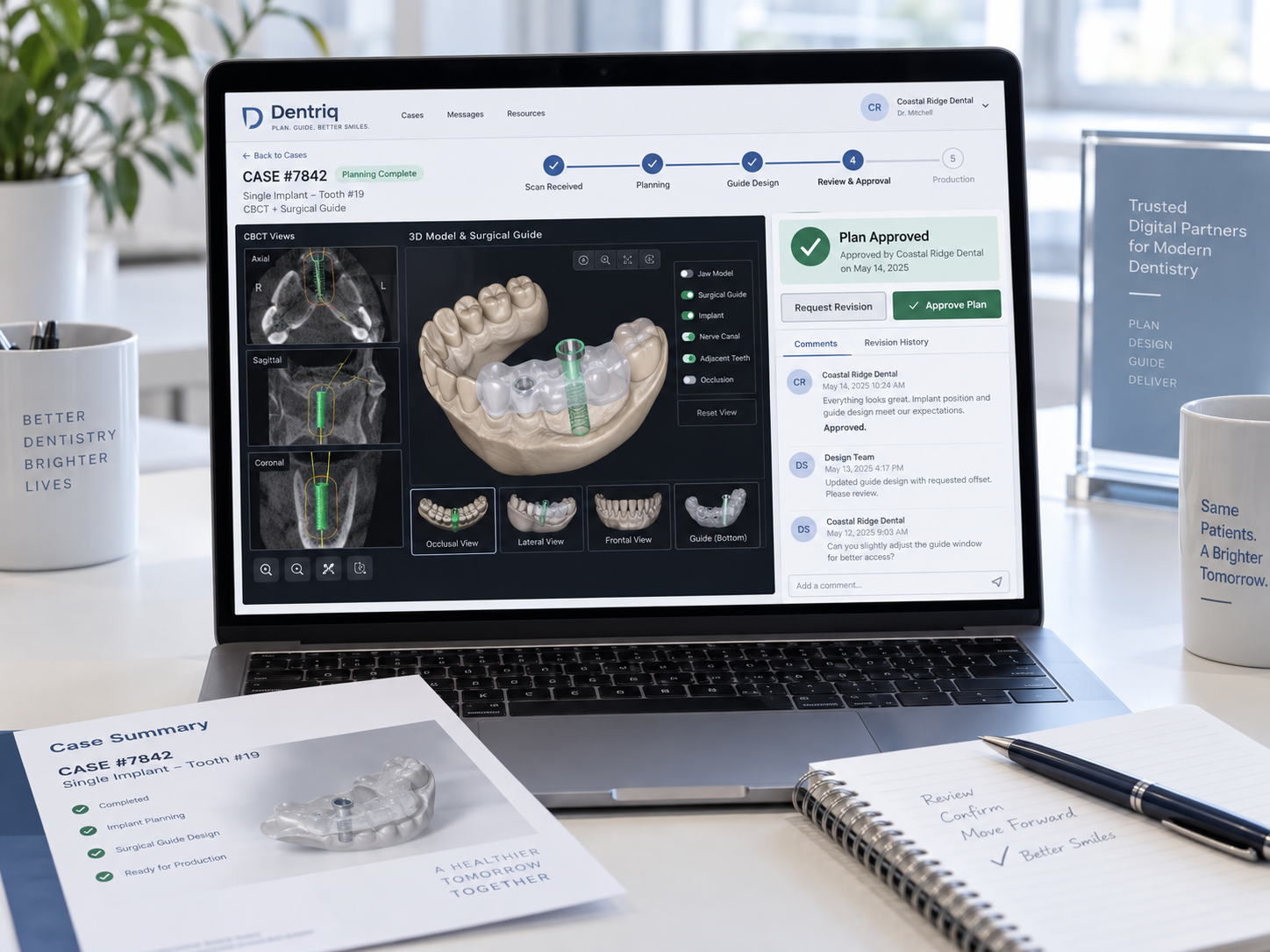
The approved version should be clearly identified, previous versions should not remain ambiguous, and fabrication should only begin after the correct file has been released through the agreed approval process.
This sounds simple, but in a complex workflow, version confusion can undo otherwise good design work very quickly.
Decision Rule
Fabrication-ready is not a file status. It is a handoff condition.
A full-arch design is ready to move into fabrication when the important design decisions have been reviewed, unresolved conflicts have been clarified, the output fits the intended fabrication workflow, and the correct version has been approved for release.
What Makes an Outsourcing Partnership More Reliable Over Time?
A good trial case proves that a team can complete one case.
A good long-term outsourcing relationship should prove something more: the workflow gets easier to run without becoming less controlled.
That means the external team should gradually learn how the lab works, understand which preferences are already established, recognize which situations are genuinely unusual, and use feedback from previous cases to improve the next one.
If every case still has to be explained from zero after months of cooperation, the relationship may be buying repeated CAD labor rather than building a dependable design capability.
Consistency Is More Than Repeating the Same Preset
Consistency does not mean making every full-arch case look the same. Different implant positions, restorative space, tissue conditions, materials, and restorative goals should produce different design responses.
What should remain consistent is the decision logic: similar conditions should be handled in similar ways, known warning signs should trigger the right level of attention, and established standards should not change with the designer or the workload.
That is why consistency is better judged across a series of cases than from one impressive design.
Can the same design standard hold across different cases, different designers, and changing case volume?
Preferences Should Become Repeatable Design Rules
Every lab has preferences that go beyond general CAD knowledge.
They may involve occlusion, contacts, contour, emergence profile, hygiene access, file organization, review points, or how much freedom a designer has before asking for confirmation.
In long-term collaboration, these preferences often become clear through repeated review and correction. If the same contact is adjusted repeatedly, the same contour is changed from case to case, or the same type of question keeps coming back, the issue is no longer limited to one case. A working rule is still missing.
Once that pattern is clear, it should become part of the standard for future cases.
The goal is not to remember more instructions. It is to turn repeated corrections into repeatable design rules.
That reduces unnecessary communication while keeping review and control where they are still needed.
Questions Should Become More Selective, Not Simply Fewer
As an outsourcing relationship matures, communication should become more selective.
Routine situations that have already been standardized should no longer create the same back-and-forth. Unusual anatomy, conflicting instructions, missing information, unexpected implant positions, or fabrication constraints should still trigger clarification.
Repeated routine questions suggest that previous decisions have not yet become part of the workflow. No questions at all may mean assumptions are replacing clarification.
The goal is selective communication: fewer repeated questions, with faster recognition of the questions that still matter.
Fabrication and Revision Feedback Should Improve the Next Case
The value of feedback is visible in what changes afterward.
If fabrication repeatedly exposes the same thickness issue, the next similar case should not arrive with the same design problem. If the same contour is repeatedly corrected internally, that preference should begin to appear in later designs. If revisions keep returning for the same reason, the cause should be identified and the workflow adjusted rather than treating each case as an isolated correction.
This creates a simple test of whether the outsourcing workflow is actually learning:
Does feedback from one case change how the next similar case is handled?
The loop should look something like this:
Design → Review → Fabrication / Revision Feedback → Rule Update → Next Case
If the same problems continue to return unchanged, experience is accumulating as case volume only.
If the response changes, experience is becoming part of the workflow.
Scale Design Capacity Without Scaling Management Burden at the Same Rate
This is where long-term outsourcing creates real operational value.
When case volume increases, design capacity should be able to increase without requiring the lab to add the same amount of checking, explanation, follow-up, and internal correction.
That does not mean management work disappears. Complex cases will still require review, exceptions will still need discussion, and final approval still needs an owner.
But routine work should become easier to hand off.
If twice the volume creates twice the communication and twice the internal correction, the outsourcing relationship has added labor capacity but not much workflow leverage.
A stronger partnership behaves differently: routine decisions become standardized, important exceptions become easier to identify, and management attention is concentrated where it actually adds value.
Decision Rule
A reliable design partnership should learn.
Over time, established preferences should become repeatable rules, routine questions should decrease, important exceptions should become easier to recognize, and feedback from fabrication or revision should improve the next case.
If the same requirements still need to be explained from zero months into the relationship, the workflow is probably buying repeated CAD labor—not building a long-term external design capability.
Conclusion: Build a Design Capability, Not Just Outsource CAD
A reliable full-arch outsourcing workflow does not start with the question, “Who can design this case?”
It starts one level earlier:
What part of the workflow actually needs outside capability, and what must that external team understand, decide, and hand back reliably?
That is why good All-on-X & Full-Arch CAD Design cannot be judged by the final STL alone. The design is only one part of a connected system. It depends on a clear restorative goal, usable case context, sound judgment when constraints compete, and a controlled handoff into fabrication.
The same is true of the outsourcing relationship itself. A strong partner should not require more checking, repeated instructions, and internal correction as case volume grows. Over time, routine preferences should become repeatable rules, important exceptions should become easier to recognize, and feedback from one case should improve the next.
These are also practical signals to look for when evaluating an external full-arch design partner. The question is not only whether the team can complete the CAD, but whether the collaboration becomes easier to run while the important decisions remain controlled.
The real value of outsourcing appears when external design capacity becomes part of the workflow rather than another step that has to be managed around.
A practical way to evaluate that is to begin with a small number of representative cases and review more than the final files. Look at how the team handles case context, conflicting constraints, questions, revisions, approval, and the handoff into fabrication.
If external All-on-X / Full-Arch design support is being considered, Raytops can begin with a trial workflow built around the lab’s existing standards, review process, and fabrication requirements.
For labs evaluating a new full-arch design partner, the safest next step is usually not to move a large volume at once. Start with a small number of representative cases, define the scope, inputs, review points, and fabrication requirements clearly, and see how the workflow performs before scaling.