01
More Predictable Implant Placement
Plan position, depth and angulation from combined anatomical and restorative data before guide design begins.
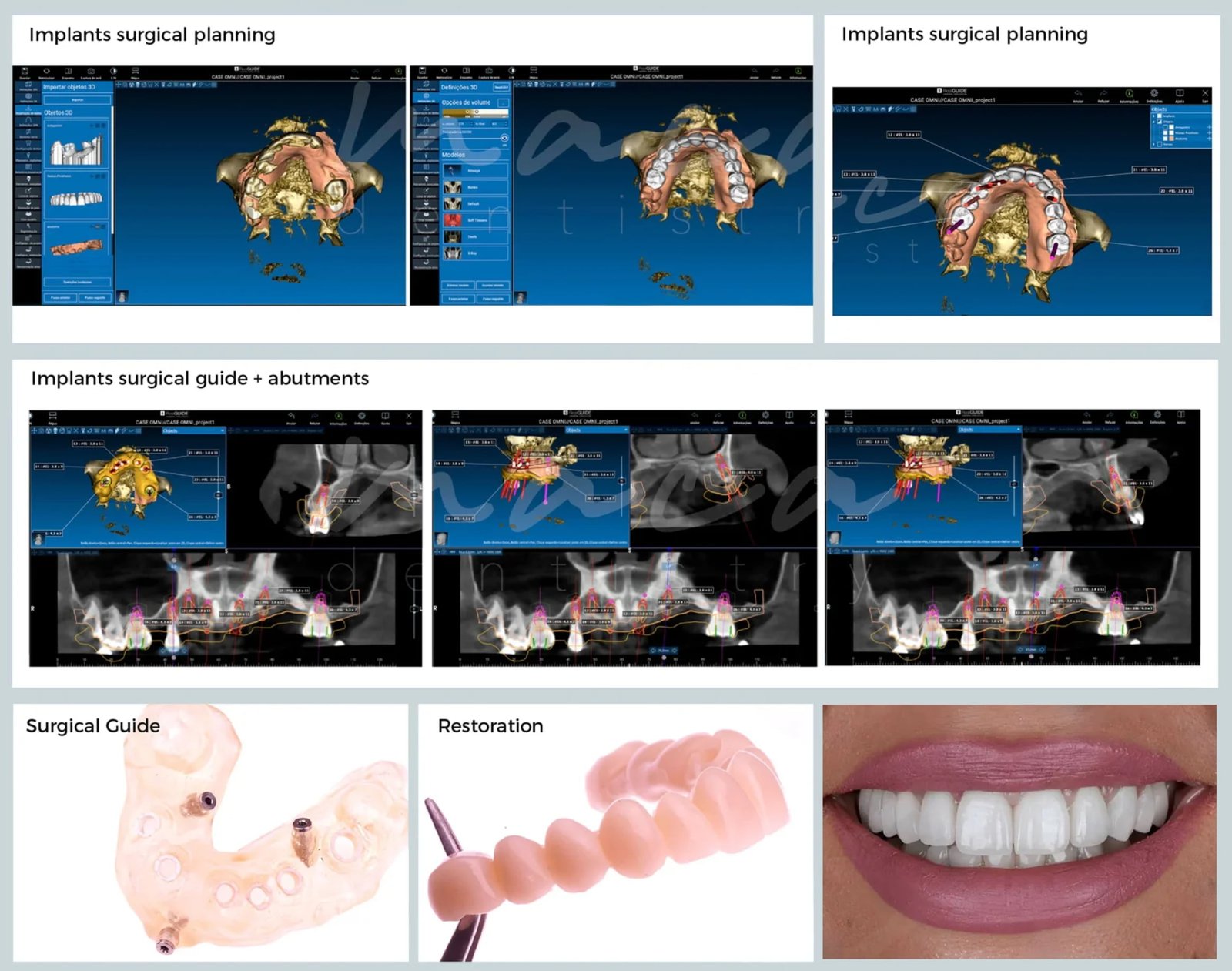
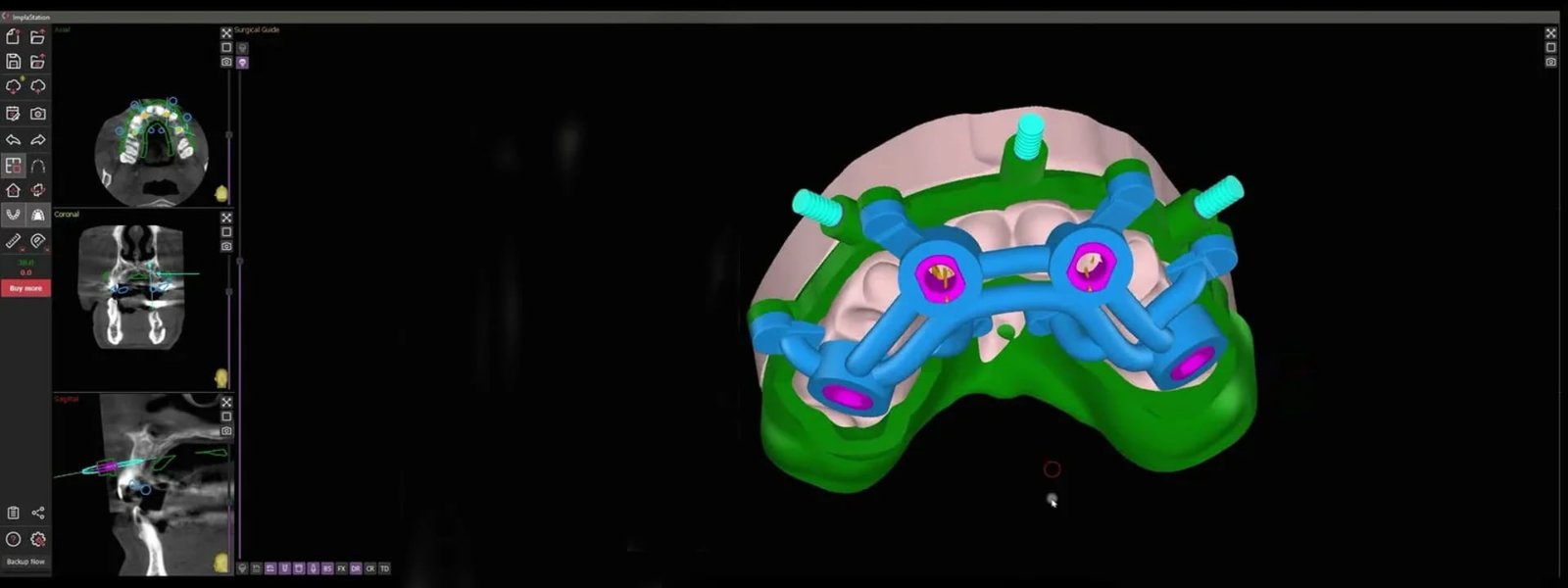
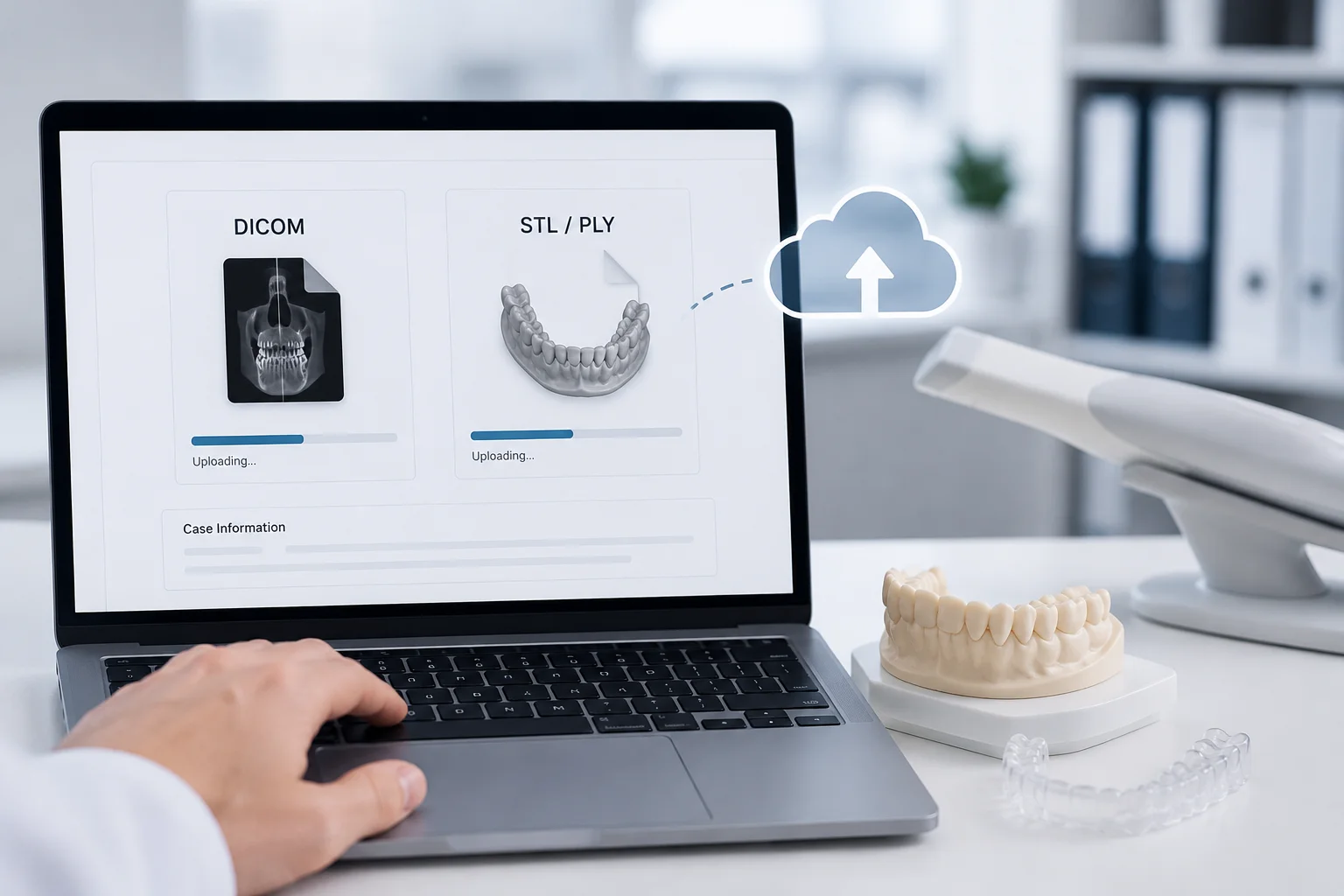
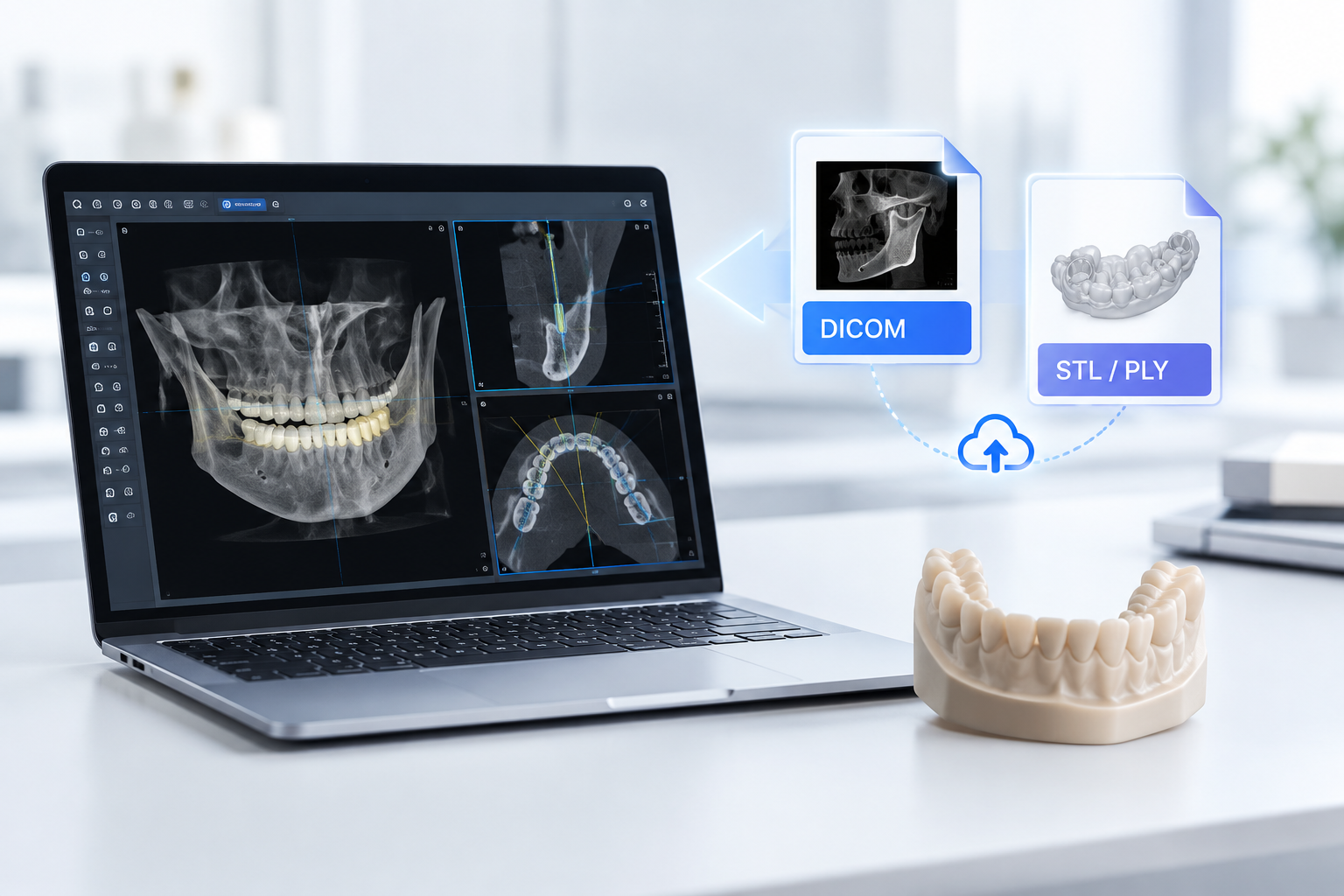
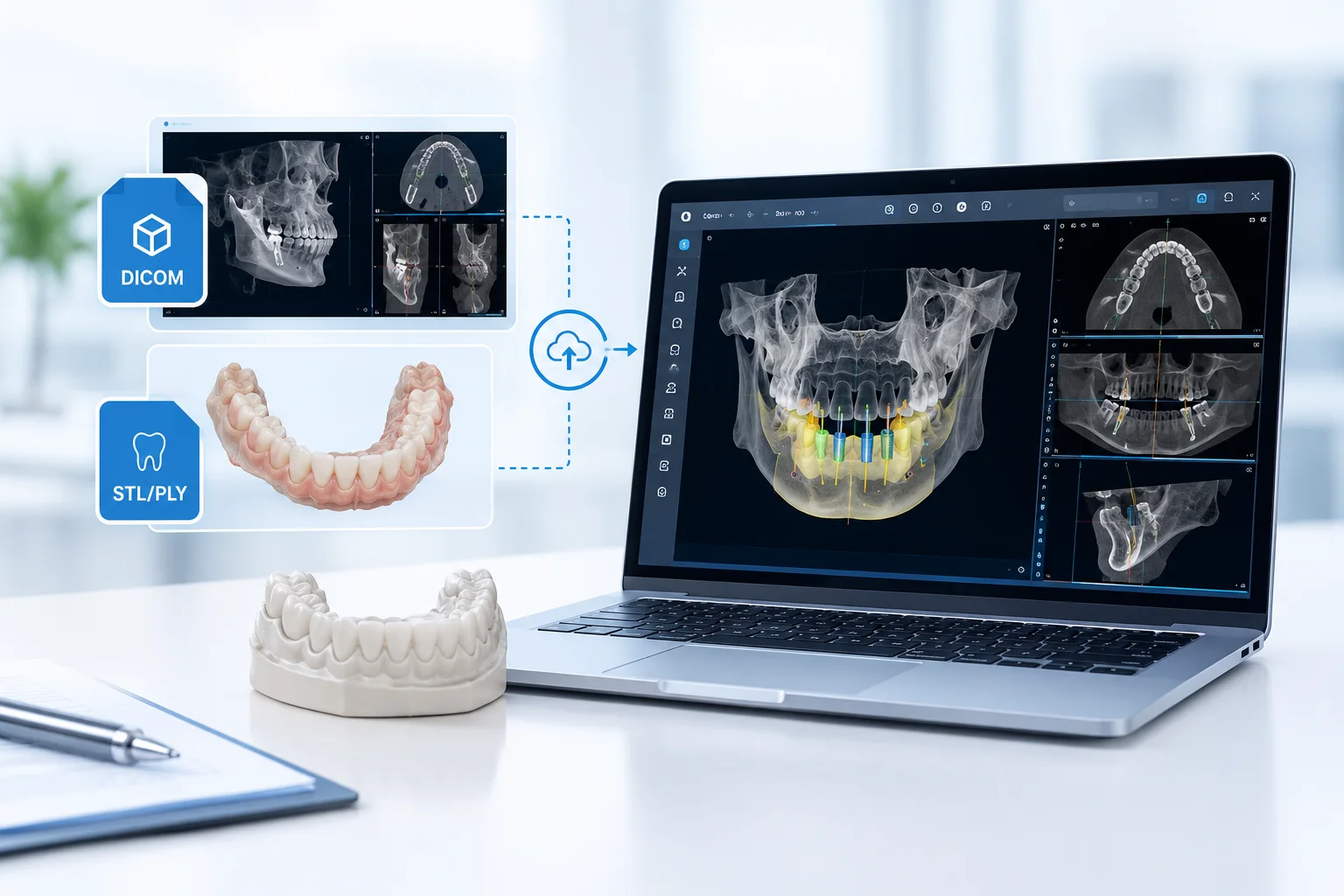
Outsource implant planning and surgical guide design without building the workflow in-house. Predictable surgical guide design starts with correct implant planning around the intended restoration—not with the guide geometry itself. Raytops combines CBCT/DICOM with STL or PLY data to plan implant positions and create fabrication-ready surgical guides for single implants through complex full-arch cases.
✅ CBCT + STL / PLY-Based Planning
✅ Prosthetically Driven Implant Planning
✅ Single Implant to Complex Full-Arch Cases
✅ Planning + Guide Design & Optional Fabrication
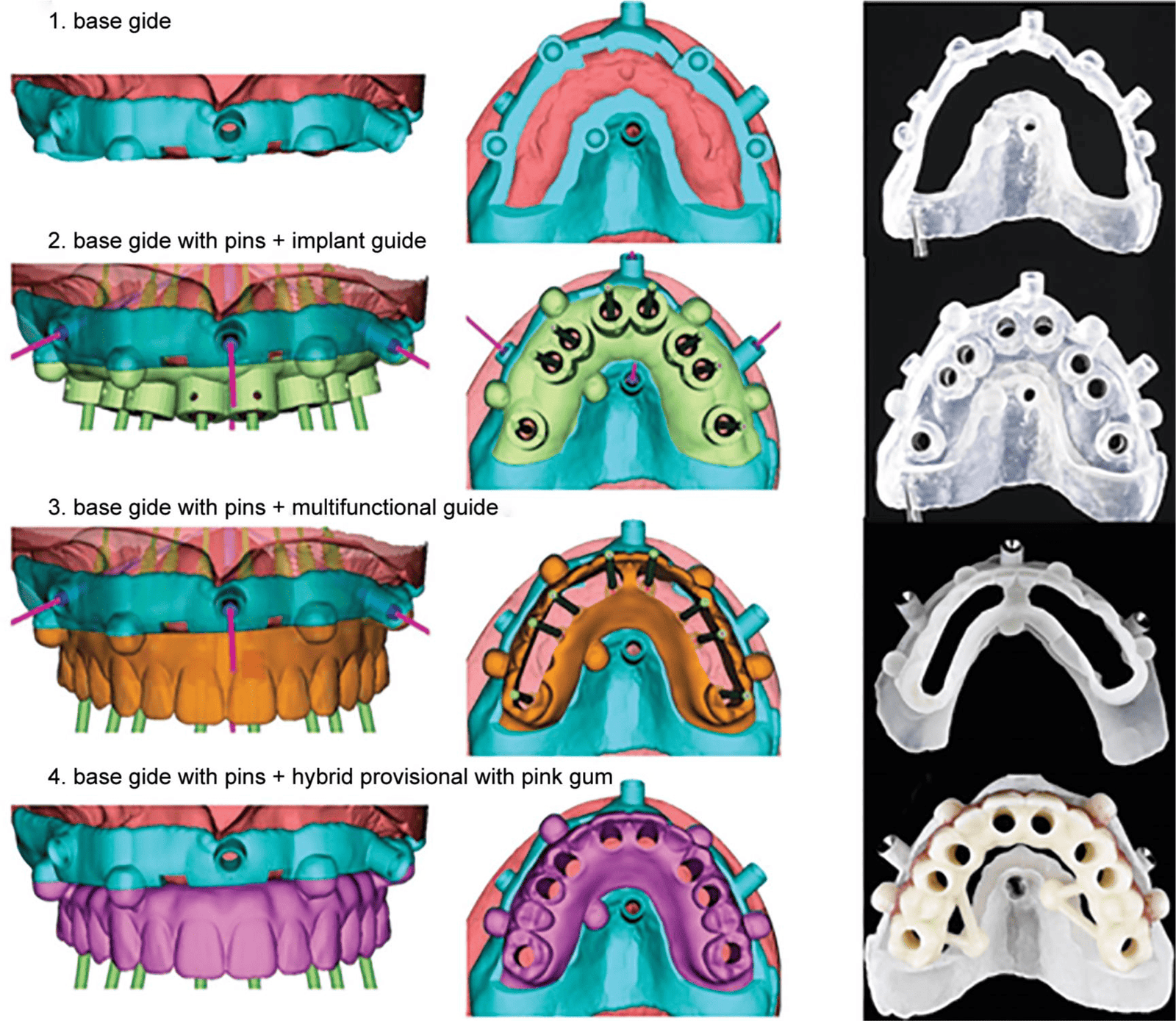
Our surgical guide service can support the workflow at different stages—from guide design based on an approved implant plan to complete planning, guide design and fabrication. We work with CBCT/DICOM and STL or PLY data for prosthetically driven implant planning and can support single implants through complex full-arch workflows, including tooth-, mucosa- and bone-supported guides, the workflow can also continue into PMMA provisional and final restorative fabrication when required.
A More Predictable Implant Workflow, With Less Work In-House
Keep implant planning aligned with the intended restoration while reducing the digital planning, design and coordination your team needs to manage in-house.
Plan position, depth and angulation from combined anatomical and restorative data before guide design begins.
Keep implant planning and downstream restoration working toward the same intended restorative position.
Support multi-implant and complex full-arch cases without building every planning capability in-house.
Outsource alignment, planning and guide design without adding software, technician capacity or a dedicated planning team.
Keep the stages you already handle and outsource only the parts of the workflow you need.
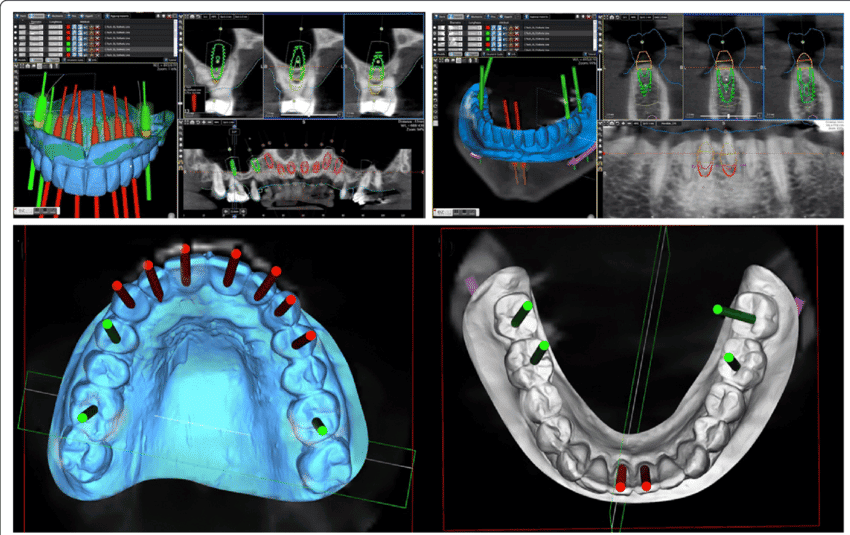
Use the full workflow or enter at the stage you need. Send the available case data and requirements, and we confirm the service scope before work begins. We then complete planning and/or guide design, return the case for review and approval, and deliver the finalized files or continue with fabrication when selected.
Practical answers to the questions that matter when evaluating a surgical guide planning and design partner—from case data and implant-system compatibility to design review, revisions, turnaround, 3D printing, guide fit and final clinical approval.
For implant planning and surgical guide design, the core data normally includes CBCT/DICOM files, intraoral or model scans in STL or PLY format, and the case instructions. Implant system, guided surgery kit, sleeve information and the intended restorative setup should also be provided when applicable.
For full-arch or restorative-driven cases, additional records such as a wax-up, provisional design, opposing arch, bite scan or other restorative references may be required depending on the workflow.
Please provide the implant brand and system, planned implant components, guided surgery kit and sleeve type or reference whenever these affect the guide design.
For fully guided workflows, the drill sequence, sleeve geometry and vertical offset must correspond to the intended guided surgery system. If compatibility is unclear, it should be confirmed before the guide is finalized rather than assumed from the implant brand alone.
Implant planning should not proceed until the CBCT/DICOM and surface scan registration can be verified with sufficient confidence.
If the datasets do not align reliably, the case should first be checked for CBCT artifacts, incomplete scan coverage, distorted surface data or insufficient matching anatomy. Additional or replacement data may be required before planning continues.
The implant plan and/or guide design is returned for review before the case is finalized. Implant position, depth, angulation, restorative relationship and relevant guide-design details can be reviewed according to the service scope.
If changes are required, revisions are made before final approval and file delivery or fabrication.
Revisions can be made to the parts of the case included in the selected service scope before final approval.
For planning cases, this may include implant position, depth, angulation or restorative relationship. For guide design, changes may involve guide geometry, support, sleeve position, inspection windows, fixation features or other case-specific design requirements.
Final fabrication should begin only after the relevant planning and design stages have been approved.
Surgical guide planning and design typically takes 8–48 hours once the required case data and instructions are complete. Turnaround depends on case complexity, data quality, the level of planning required, and whether additional review or revisions are needed before finalization.
Yes. For design-only cases, the finalized surgical guide can be delivered as a fabrication-ready STL for in-house or local production.
If your printing workflow uses specific sleeve dimensions, offsets, tolerances or other validated production parameters, provide those requirements before finalization so the design can be matched to the intended fabrication workflow where applicable.
Final review should confirm that the guide still represents the approved implant plan and that the design is suitable for the intended surgical and fabrication workflow.
Key checks can include guide seating and support, implant and sleeve position, sleeve offset, fixation requirements, inspection access, guide geometry and final file integrity. If Raytops also fabricates the guide, manufacturing QC becomes a separate downstream control step.
A guide-fit problem should first be traced to the stage where the discrepancy was introduced rather than automatically treated as a design error.
Possible causes include inaccurate surface scans, registration errors, incorrect CAD offsets, printer calibration, resin dimensional change, printing orientation, washing or post-curing, and sleeve insertion. Comparing the approved digital design with the printed guide helps separate a design issue from a fabrication issue.
The treating clinician should retain final clinical approval of the patient-specific implant plan before the case proceeds to final guide fabrication.
Raytops can support data alignment, implant planning, guide design and technical review, but the proposed implant position must ultimately be reviewed and accepted by the clinician responsible for the surgery.
A surgical guide can make implant placement more controlled and predictable, but only when planning, design and fabrication work as one connected system.
Reliable transfer depends on accurate clinical data, correct registration, a sound implant plan, stable guide support, usable sleeve access and a fabrication workflow that matches the intended surgical system.
The quality of a surgical guide is ultimately measured by how reliably the approved implant position is carried from the digital plan into surgery.
Guide design begins downstream of a clinical decision: where the implant should actually be placed.
A useful implant position has to satisfy three conditions together:
Restorative Objective × Anatomy × Surgical Feasibility
The intended restoration helps define the preferred implant position and angulation, while available bone, anatomical structures and surgical access determine whether that position is clinically feasible. This restorative-driven logic appears repeatedly in professional surgical-guide workflows, where planning is tied to the final restorative result rather than treated as an isolated surgical step.
Depending on the case, planning may need to consider:
A practical way to think about it is:
Bone shows where an implant may be placed; the intended restoration helps determine where it should be placed.
But this is not a “restoration at any cost” rule. If the preferred restorative position conflicts with anatomy, bone availability or surgical access, the plan has to be adjusted.
If implant positions have already been clinically reviewed and approved, the workflow can begin directly at guide design.
The approved plan still needs to be checked against design feasibility, including:
An approved implant plan is the design basis, not proof that the guide is already fabrication-ready.
Planning decides where the implant should go. Guide design decides whether that position can be transferred into a stable, accessible and usable guide.
Having the right file types is only the starting point. A case is ready for planning only when the data are usable, complete and reliably registered.
For most digital workflows, the core inputs are:
The real question is not:
Do we have the files?
It is:
Can these files support a reliable planning and guide-design decision?
CBCT provides the anatomical information that surface scans cannot: available bone and the relationship of the planned implant to structures such as the sinus, nerve canal and surrounding anatomy.
But a DICOM file is not automatically usable just because it opens correctly.
Planning can be compromised by:
A useful QC question is:
Is the anatomy clear enough to support the decisions this case requires?
If not, guide design cannot compensate for unreliable source data.
Surface scans provide the high-resolution geometry needed for:
A simple distinction is:
CBCT provides the anatomical environment; STL/PLY provides the detailed surface and restorative reference.
Where both are required, neither replaces the other.
Edentulous workflows often need extra references because stable dental landmarks are absent.
Depending on the case, this may include:
The key point is:
The data-acquisition protocol should match the planned guide support and restorative workflow.
For example, if an existing denture is used as a registration reference, its fit matters. A poorly fitting denture is not automatically a reliable planning reference simply because the patient already wears it. SurgicalGuides.com specifically emphasizes denture fit, marker stability and occlusion in dual-scan workflows.
This is one of the most important checkpoints in the digital workflow.
Having a clean CBCT and a clean STL does not prove that the two datasets are correctly aligned.
Registration determines whether the surface geometry, anatomy and restorative reference occupy the correct spatial relationship in the planning software.
Potential problems include:
File availability is not registration accuracy.
A case can therefore contain two apparently good files and still produce a poor combined dataset.
If registration is wrong, every downstream step can still look precise:
Registration error → precise planning → precise guide design → wrong clinical reference
That is why registration deserves its own QC checkpoint.
If the alignment cannot be validated confidently, planning should stop before false precision is carried downstream.
Not every imperfection requires a new scan. The important question is whether the defect affects a planning-critical reference.
Typical reasons to stop and review include:
This gives us a more useful pre-planning check:
Before planning, confirm:
A case is ready to move forward when the information needed for the next decision is trustworthy—not merely when the required file extensions are present.
A clinically acceptable implant plan still has to be translated into a guide that can seat completely, remain stable, provide usable surgical access and work with the intended guided system.
That translation is the core job of guide design.
Planning defines the intended implant position. Guide design determines whether that position can be transferred into a clinically usable device.
Every guide needs a reproducible reference in the mouth.
Depending on the case, support may come from:
The design should allow the guide to return to the same position each time it is seated.
For tooth-supported guides, practical variables include:
SurgicalGuides.com specifically identifies tooth mobility, undercuts, passive fit and retention as real design considerations.
A guide can look perfect on the CAD screen and still fail clinically if it:
Guide accuracy depends on reproducible seating, not just correct digital geometry.
If the guide does not occupy the same reference position used during planning, the sleeve no longer represents the planned trajectory exactly.
Once the implant axis is defined, the sleeve must be positioned so the intended instrumentation can actually be used.
Key variables include:
SurgicalGuides.com explicitly notes horizontal/vertical sleeve offsets and limited drill access as practical design variables. It also gives a useful example: when there is insufficient space between adjacent teeth for a fully guided sleeve, a pilot guide may be more practical.
The important question is therefore not only:
Can the sleeve be positioned on the planned implant axis?
but:
Can the surgeon physically use the intended drill and guided instrumentation through it?
Posterior sites are especially sensitive to vertical access.
A guided workflow adds physical height:
Guide + Sleeve + Drill + Handpiece
A digitally correct trajectory may still be clinically unusable if the instrument stack cannot enter the mouth.
The plan may be correct and the sleeve may be correctly positioned, but the drill cannot physically reach the site.
Depending on the case, the response may include:
Clinical access should be checked before guide design is finalized, not after fabrication.
The guide must be stable enough to transfer the plan, but making it larger is not automatically better.
Guide extension influences:
The design therefore has to balance stability and accessibility.
Where natural support is insufficient, fixation may be added, but fixation itself introduces new planning variables:
A useful design question is:
What level of support and fixation is actually needed to keep this guide reproducibly stable?
More complex cases may require the guide to do more than direct drilling.
Possible features include:
In full-arch workflows, the “guide” may actually be a sequence:
Reference / Fixation → Bone Reduction → Implant Placement → Provisional Transfer
The core principle is:
As case complexity increases, guide design becomes a workflow-coordination problem, not just a single-object CAD task.
Guide selection should follow the case condition and surgical task, not a flat list of guide types.
A practical decision path is:
Case Condition → Available Support → Surgical Task → Access Constraints → Guide Strategy
That matters because support type, guidance level and surgical function are different decisions. A tooth-supported guide can be fully guided; a mucosa-supported guide can also be fully guided; a stackable workflow may combine several guides with different functions. Treating all of these as equivalent “guide types” hides the real design logic.
Tooth-supported guides are generally preferred when stable remaining teeth can provide a reproducible reference.
The important question is not simply whether teeth are present, but whether they provide rigid, repeatable support.
Key variables include:
SurgicalGuides.com specifically identifies tooth mobility, undercuts, passive fit, retention and drill access as practical design factors.
Tooth-supported guidance depends on reproducible support, not merely the presence of teeth.
If the supporting teeth are unstable or the guide cannot seat consistently, another support strategy may be more appropriate.
Mucosa-supported guides are typically used in fully edentulous workflows where teeth are unavailable as a rigid reference.
These cases often depend more heavily on:
The main limitation is mechanical: mucosa can compress or shift under load.
That does not make mucosa-supported guidance unreliable by definition, but it does change the stabilization requirements.
The less rigid the support, the more carefully seating and fixation need to be controlled.
This is why support strategy and input-data strategy are connected in edentulous cases. SurgicalGuides.com links mucosa-supported workflows with dual-scan protocols and additional data requirements rather than treating support as a purely downstream design choice.
Bone-supported guides use exposed bone as the reference surface and are usually associated with workflows that already require flap reflection.
They may be considered in cases involving:
SurgicalGuides.com links bone-supported designs with edentulous cases and alveoloplasty workflows.
The key point is:
Bone-supported is not simply “more accurate”; it solves a different support problem within a different surgical approach.
Guide support should match the structure that can be exposed, positioned and stabilized reliably during the planned procedure.
The amount of guidance should also match the available space and instrumentation.
A fully guided workflow may control multiple drilling steps and, depending on the system, implant insertion. A pilot guide may control only the initial osteotomy or entry direction.
More guidance is not automatically better.
SurgicalGuides.com gives a useful example: when the space between adjacent teeth is too limited for a fully guided sleeve, pilot guidance may be more practical.
This creates a strong Fence:
Use the level of guidance that can actually be executed clinically, not the maximum level available in the software.
Typical reasons to reduce the level of guidance may include:
Complex full-arch cases often need a sequence of guides rather than one device.
A typical sequence may be:
Reference / Fixation → Bone Reduction → Implant Placement → Provisional Transfer
The important design question becomes:
How will the same spatial reference be preserved across every stage?
As the number of surgical and restorative steps increases, guide strategy becomes a workflow-coordination problem, not simply a guide-selection problem.
Instead of memorizing categories, ask four questions:
The best guide strategy is the one that provides stable support, usable access and the level of guidance required for the actual surgical task.
Surgical guide accuracy is cumulative. It depends on the entire chain, not on one CAD parameter or one printer specification.
Data Acquisition → Registration → Planning → Guide Design → Sleeve / System Compatibility → Fabrication → Seating → Surgical Transfer
A guide can be designed precisely relative to a digital plan and still produce a clinically different result if error entered earlier—or if the guide is fabricated, seated or used differently from the conditions assumed during planning.
This is why “high-precision surgical guide” is incomplete by itself. The better question is:
Where can deviation enter the workflow, and which checkpoints can catch it before surgery?
This chain is supported by the competitor/source analysis, which repeatedly identifies scan quality, registration, support, sleeve access, fabrication and clinical seating as separate contributors to final accuracy.
Error can enter before planning begins.
Typical sources include:
SurgicalGuides.com gives a very practical example: patient movement can create a double-image defect that should be caught before planning continues.
A precise guide cannot recover information that was already inaccurate at the source.
CBCT/DICOM and STL/PLY must occupy the correct spatial relationship before implant planning becomes meaningful.
A clean CBCT and clean STL can still be poorly registered.
That creates one of the most dangerous error patterns:
Wrong alignment → precise planning → precise guide design → wrong clinical reference
The same principle applies to implant planning itself. A technically precise plan can still be inappropriate if implant position, anatomy, restorative objective or surgical feasibility are misjudged.
Precision is not the same as correctness.
Registration and planning therefore need separate validation before the case proceeds downstream.
Even with a sound plan, design can introduce deviation through:
The core rule is:
Guide geometry is only accurate if the guide can reproduce the same clinical reference position used during planning.
This is why support, seating and access are accuracy variables—not just convenience features.
A surgical guide is not finished when the STL is exported.
Production adds another layer of variables:
JDentalCare’s material makes this relationship clear by connecting bushings, implant diameters, software and guided instrumentation instead of treating the sleeve as a generic component.
A fabrication-ready guide is specific to the production and surgical system it is intended to work with.
If design and fabrication are separated, these parameters need to be confirmed before finalization.
The final checkpoint happens in the mouth.
Potential problems include:
A guide that does not fully seat no longer occupies the same position used during planning.
The final accuracy checkpoint is clinical seating, not the CAD screen.
Before drilling begins, the guide should therefore be checked for:
The most useful way to evaluate accuracy is not to ask for one tolerance number.
Ask whether each stage preserves the decision made before it:
Reliable Source Data
→ Validated Registration
→ Sound Implant Plan
→ Clinically Workable Guide Design
→ Compatible Fabrication
→ Stable Seating
→ Reliable Surgical Transfer
This gives a stronger decision rule:
The goal is not to make one stage extremely precise; it is to prevent small errors from accumulating across the workflow.
Surgical guide outsourcing does not need to follow one fixed package.
The right scope depends on which parts of the workflow are already clinically and technically controlled.
A simple way to think about it is:
Approved Plan Available → Design Only
Planning Still Needed → Planning + Design
Production Variables Need Control → Planning + Design + Fabrication
The goal is not to outsource more. It is to avoid weak handoffs between stages that depend on the same plan.
Design-only support fits cases where the implant plan has already been clinically approved and the downstream production requirements are known.
Typical conditions include:
In this model, the design team starts from the approved plan and focuses on converting it into a stable, accessible and fabrication-ready guide.
Design-only works best when both the clinical plan and the downstream production assumptions are already defined.
An approved plan still needs a guide-feasibility check for support, seating, sleeve position, access and system compatibility.
Planning and design are better kept together when guide feasibility can affect the implant plan.
Typical examples include:
A plan can be clinically acceptable, but guide design may later reveal that:
If guide feasibility can change the plan, planning and design should remain connected.
Design and fabrication can be separated, but only when the production variables are already clear.
These may include:
JDentalCare’s material shows this connection directly by tying bushings, implant diameters, software and guided instrumentation together.
The key point is:
A printable STL is not automatically fabrication-ready for every production system.
If design and fabrication are handled by different teams, the production assumptions should be confirmed before the design is finalized.
A fuller workflow can be useful when several stages depend on the same digital reference:
Planning → Guide Design → Guide Fabrication
and, in more complex cases:
→ Provisional Restoration → Final Restoration
This is especially relevant in full-arch and stackable workflows, where surgical and restorative steps need to remain coordinated.
The important reason is not simply “fewer suppliers.”
It is:
Every handoff must preserve the same implant coordinates, support assumptions, sleeve parameters and restorative reference.
The more stages that depend on the same spatial reference, the more costly a weak handoff becomes.
Ask three questions:
The best outsourcing scope is the smallest scope that still keeps the critical decisions and production assumptions under reliable control.
Surgical guide outsourcing should make the workflow more efficient without removing clinical control.
The most reliable model separates two responsibilities:
Technical preparation identifies whether the case can be planned, designed and fabricated reliably.
Clinical approval confirms whether the proposed implant position and surgical strategy are acceptable for the patient.
That distinction is important because a surgical guide is not a routine CAD file that should move directly from “design complete” to production.
Depending on the selected service scope, the technical review may include:
The goal is not simply to finish the CAD.
It is to answer:
Can the clinical intention be transferred into a guide that can actually be seated, fabricated and used with the intended surgical system?
If that answer is uncertain, the case should stop for clarification or revision.
The clinician should review the decisions that remain clinical in nature, including:
Technical planning support does not replace clinical approval.
This is not only a responsibility issue. It is also a workflow-quality issue: the design team can identify technical conflicts, but the clinician decides whether the proposed treatment plan is clinically acceptable.
Revision is not a failure. In this workflow, it is often the point where a downstream problem is prevented.
Common triggers include:
A useful rule is:
If an unknown variable can change implant position, guide fit, surgical access or system compatibility, clarify it before finalization.
Do not solve uncertainty by making an invisible assumption.
Once the plan and guide are approved, the workflow can follow one of two main paths:
Design-only
Approved guide design → Final STL → Customer fabrication
Full-service
Approved plan/design → Fabrication → QC → Delivery
In more complex full-arch workflows, the same approved digital reference may continue into provisional or restorative stages.
The important point is not which path is chosen.
It is that the approved plan, guide parameters and production assumptions remain consistent through the handoff.
Before a case is finalized, five questions should be answered:
A case is ready for finalization only when both clinical intent and technical feasibility are clear.
Send us your requirements and our technical team will reply with a practical recommendation.