Partials Dental Lab
-
10+ years experience for China dental lab outsourcing services -
Processing 10,000 dental cases each month -
4 days Turnround time -
5 years warranty support

Raytops Partials Dental
All Ceramic Crowns & Bridges are a popular choice in modern dental restorations, offering a perfect blend of strength, durability, and natural aesthetics. Made from advanced materials like zirconia or alumina, these restorations mimic the look and feel of natural teeth while providing excellent performance. Zirconia, known for its high strength and resistance to wear, is commonly used for both single crowns and bridges.
The process begins with taking accurate impressions or digital scans of the patient’s teeth, followed by design using CAD/CAM technology. The restoration is then milled, sintered, glazed, and polished to ensure durability and a natural, tooth-like appearance.
All-ceramic crowns and bridges are ideal for patients seeking metal-free, highly aesthetic, and long-lasting dental solutions. With ongoing advancements in technology, these restorations continue to deliver exceptional results in both function and appearance.
Featured Flexible Partials Dental

Cast Framework
Cast framework partial dentures are made with a metal framework, providing superior strength and durability. This type of partial denture is designed for patients who have more extensive tooth loss and require a stable and functional solution. The metal framework offers excellent retention and support, making it ideal for patients who need a long-lasting and reliable denture.
-
Use Case:
Ideal for patients with significant tooth loss who need a strong, durable partial denture. It’s the preferred choice for those who need support for multiple missing teeth. -
Key Benefit:
The cast metal framework ensures strength and stability, providing excellent support for chewing and everyday use. This option is designed to withstand daily wear and provides a secure, long-lasting fit. -
Recommended For:
Patients with multiple missing teeth or those who need enhanced durability and strength for a functional, reliable solution.
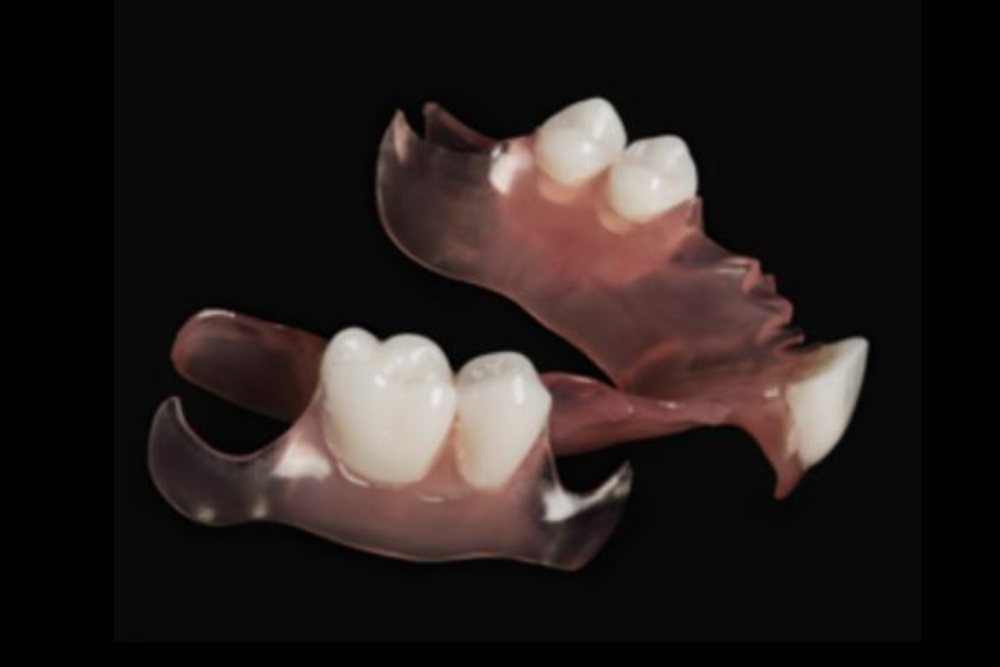
VALPLAST Flexible Partial
VALPLAST flexible partial dentures are made from a unique, flexible material that adapts to the shape of the patient’s mouth. These dentures are especially beneficial for patients who want a more natural-looking, comfortable, and discreet solution. The material used in VALPLAST dentures mimics the natural appearance of gums, providing a seamless fit and making it less noticeable when worn.
-
Use Case:
Perfect for patients who want a more aesthetically pleasing solution, especially those with visible tooth loss or who want comfort and flexibility. -
Key Benefit:
VALPLAST material is flexible and light, offering superior comfort and a natural appearance. These dentures are discreet, adaptable, and designed to offer a smooth fit. Optional for patients seeking both function and aesthetics. -
Recommended For:
Patients who prioritize comfort, natural aesthetics, and a more flexible solution for missing teeth, especially those with visible tooth loss.

Custom Flexible Partials
Custom flexible partial dentures are tailored to fit the patient’s specific needs. These dentures are designed with flexible materials, similar to the VALPLAST option, but they are fully customized to suit the patient’s unique tooth structure, aesthetics, and functional requirements. Custom flexible partials are ideal for patients who need both comfort and precision.
-
Use Case:
Ideal for patients who require a fully customized solution that offers both comfort and aesthetics. It’s made to match the specific oral anatomy. -
Key Benefit:
These partial dentures are completely customized to fit the patient’s needs, providing superior comfort and a highly natural look. The flexible material ensures that easy to wear and fit for patients with complex requirements. -
Recommended For:
Patients who need a fully customized, flexible solution for tooth loss and who want a high degree of comfort, aesthetic appeal, and precise fit.
High-Quality Removable Partials for Durable and Comfortable Dental Solutions
Benefits
Product Overview & User Benefits
Partials Dental is a type of removable partial denture designed for patients with missing teeth. Unlike full dentures, which replace all teeth, partial dentures are custom-made to fill in gaps where only a few teeth are missing. They restore both the functionality and aesthetic appearance of the patient’s smile, offering a more comfortable and personalized solution. Whether replacing a single tooth or several teeth, Partials Dental provides a high-quality solution that allows patients to regain their chewing ability and confidence.
This removable option is an ideal choice for patients who do not require a full set of dentures but need a comfortable and functional solution to restore their smile. The advanced materials and precise manufacturing processes ensure that the partial dentures blend seamlessly with the natural teeth, providing a reliable and durable long-term solution.
Key Benefits
-
Precise Fit:
Partials Dental utilizes advanced digital technologies for customization, ensuring that each partial denture is a perfect fit for the patient’s oral structure. This level of precision provides an exceptional fit and maximum comfort. -
Enhanced Chewing Functionality:
The stable design of the partial denture restores the patient’s chewing ability, improving their overall eating experience. The functionality of partial dentures is comparable to that of natural teeth, significantly enhancing the patient’s quality of life. -
Natural Aesthetic Effect:
The carefully designed partial denture blends seamlessly with the patient’s natural teeth. Whether it’s the shade, shape, or bite, the denture is tailored to match the individual’s mouth, ensuring an aesthetic and comfortable result. -
Flexibility and Easy Maintenance:
Unlike fixed dentures, partial dentures are removable, making cleaning and maintenance significantly easier. Patients can take out the partial denture to clean it, reducing the buildup of bacteria and promoting oral health. -
Personalized Customization:
Each partial denture is crafted to meet the specific needs of the patient, including shade, shape, and size, ensuring a fully personalized fit. This customization ensures that the prosthetic integrates naturally into the mouth. -
Long-lasting Durability:
Made from high-strength, durable materials, Partials Dental ensures that the dentures are long-lasting and able to withstand everyday wear. The materials used are resistant to wear, making them suitable for long-term use without compromising performance or aesthetics.
Material Types & Comparison
Material Types and Comparison (Advantages, Translucency, and Strength)
When choosing the right Partials Dental product, selecting the appropriate material is critical. Different materials not only affect the comfort and durability of the dentures but also directly influence the aesthetic appearance and functionality of the restoration. In this section, we will provide a detailed comparison of the advantages, translucency, and strength of various materials, offering practical recommendations to help you choose the best partial denture for your needs.
Acrylic
Acrylic is one of the most common and cost-effective materials used for partial dentures. It is a lightweight and versatile material that can be molded to fit the patient’s mouth comfortably.
-
Advantages:
Acrylic partial dentures are affordable, lightweight, and easy to adjust. They offer a good balance between functionality and cost-effectiveness, making them a great option for patients with limited budgets or those seeking a temporary solution. -
Translucency:
Acrylic offers a moderate level of translucency, allowing it to mimic the natural appearance of teeth. However, it may not be as aesthetically appealing as other materials in terms of natural appearance. -
Strength:
While acrylic is strong enough for everyday use, it is not as durable as metal or flexible materials. It is ideal for patients with mild to moderate tooth loss who do not require extreme durability. -
Best For:
Patients looking for an affordable, lightweight option for partial dentures, especially those with limited tooth loss.
Cast Metal (Cobalt-Chrome)
Cast metal partial dentures feature a metal framework, typically made of cobalt-chrome, providing exceptional strength and durability. This material is designed for patients who have more extensive tooth loss and require a stable, long-lasting solution.
-
Advantages:
Cast metal frameworks provide excellent support and retention. The metal base ensures a secure fit, even when chewing tough foods, and the material is highly resistant to wear, making it ideal for long-term use. -
Translucency:
Cast metal partials do not offer much translucency, as the metal framework is visible. However, the acrylic teeth can be color-matched to the natural teeth, offering a more natural appearance. -
Strength:
Cobalt-chrome is one of the strongest materials used for partial dentures. It offers unmatched durability and resistance to wear, making it the best option for patients who need a robust, long-lasting denture. -
Best For:
Patients with significant tooth loss or those who need a durable, long-term solution with enhanced strength and stability.
VALPLAST Flexible Material
VALPLAST flexible partial dentures are made from a thermoplastic material known for its superior comfort and aesthetic appeal. The flexible material adapts well to the shape of the patient’s mouth, providing a comfortable and discreet solution.
-
Advantages:
VALPLAST flexible partials are discreet, comfortable, and flexible. The material allows for a more natural fit, and the design eliminates visible clasps, enhancing the aesthetic appearance of the denture. -
Translucency:
VALPLAST material offers excellent translucency, blending seamlessly with natural gum tissue. It mimics the appearance of natural gums, making it a more aesthetic option for patients concerned with the visual appearance of their dentures. -
Strength:
While VALPLAST offers exceptional comfort and aesthetic appeal, it is not as strong as metal frameworks. It is best suited for patients with mild to moderate tooth loss, as it may not withstand extreme chewing forces. -
Best For:
Patients who prioritize comfort, aesthetics, and flexibility, particularly those with visible tooth loss or those looking for a discreet and comfortable denture.
Custom Flexible Materials
Custom flexible partial dentures are tailored to fit the patient’s specific needs. These dentures use flexible materials similar to VALPLAST but are fully customized to meet individual tooth structures, aesthetics, and functional requirements.
-
Advantages:
Custom flexible materials offer the same comfort and natural look as standard flexible dentures, but they are tailored to the patient’s specific anatomy. This ensures an optimal fit and enhanced aesthetics. -
Translucency:
Custom flexible materials are designed to blend seamlessly with natural gum tissue, providing high translucency for a natural appearance that mimics the patient’s gums. -
Strength:
Custom flexible materials offer a balanced combination of comfort and strength, making them suitable for patients who need both a durable solution and a high degree of aesthetic appeal. -
Best For:
Patients who require a fully customized, flexible solution that provides both comfort and functionality, especially those who prioritize aesthetics and fit.
Material Comparison Summary
| Material | Advantages | Translucency | Strength | Best For |
|---|---|---|---|---|
| Acrylic | Affordable, lightweight, easy to adjust | Moderate translucency | Adequate for mild to moderate tooth loss | Patients seeking an economical solution for partial dentures |
| Cast Metal (Cobalt-Chrome) | Excellent durability and stability, long-lasting | Low translucency, metal framework visible | Highly durable, resistant to wear | Patients with significant tooth loss needing long-term durability |
| VALPLAST Flexible | Discreet, comfortable, flexible, aesthetic | High translucency, blends with natural gum tissue | Moderate strength, ideal for mild to moderate loss | Patients who prioritize comfort and aesthetics, especially with visible tooth loss |
| Custom Flexible Materials | Highly customized fit, natural look, and comfort | High translucency, mimics natural gums and teeth | Good balance of comfort and strength | Patients needing a tailored, flexible, aesthetic solution |
Dental lab Digital Workflow
Precision at Every Step – The Digital Workflow Behind Locator Fixed Dentures
At Raytops, we leverage cutting-edge CAD/CAM technology and digital scanning to design and manufacture Locator Fixed Dentures with precision and efficiency. Our digital workflow ensures that each denture is designed for a perfect fit, offering both functional strength and natural esthetics. From the moment we receive your scan data, we ensure a seamless transition from design to final product delivery.
🧩 Our Workflow – From Design to Delivery
1. Data Submission & Case Intake
-
Formats Accepted: STL, PLY, OBJ from all major intraoral scanners (iTero, Medit, 3Shape, etc.)
-
Model-Based Submissions: For clinics using traditional impressions, we can scan models in-house.
-
Required Information: Clear scans of implant platforms, bite registrations, occlusion preferences, and final restoration plans.
2. Custom Denture Design
-
CAD Design:
Once the scan data is received, our team uses advanced CAD software to design the Locator Fixed Denture. The design process includes:-
Titanium frame modeling for strength and stability
-
Locator attachment placement for superior retention and fit
-
Ceramic or acrylic teeth integration for optimal esthetics and function
-
Occlusion and bite adjustments to ensure compatibility with the patient’s natural bite
-
-
Precision Customization:
Every denture design is tailored to the patient’s specific anatomy and implant system. Whether it’s a single-arch restoration, full-arch restoration, or implant-supported overdenture, we ensure that each design is optimized for both strength and aesthetics.
3. Material Selection & Manufacturing
-
Titanium Frame:
The titanium frame is crafted using high-precision milling machines, ensuring that the frame fits seamlessly with the patient’s implant system. Titanium’s strength ensures that the denture will remain stable and provide long-term durability. -
Ceramic or Acrylic Teeth:
After designing the frame, we mill or hand-craft the ceramic teeth or acrylic teeth to match the esthetic requirements of the case. The ceramic is chosen for its translucency, wear resistance, and ability to mimic natural teeth.
4. Quality Control & Fit Check
-
Pre-Production Verification:
We perform a fit check for both the titanium frame and locator attachment to ensure that everything is aligned and functional. Marginal integrity, bite fit, and occlusion are verified at this stage. -
Final Fit Testing:
After the denture is fully assembled, we conduct a physical fit test to ensure that the denture will seat properly on the implants and function effectively.
5. Polishing & Final Adjustments
-
Surface Finishing:
The titanium frame is polished to ensure a smooth, comfortable fit, and the ceramic or acrylic teeth are finely polished to give a natural, lifelike appearance. -
Final Adjustments:
If necessary, we can adjust the occlusal contacts, margins, or the gingival contour to ensure the best functional and aesthetic results for your patient.
6. Packaging & Delivery
-
Accurate Packaging:
Each Locator Fixed Denture is carefully packaged with detailed labeling, including implant system, lot number, and patient-specific information for easy identification and tracking. -
Timely Delivery:
We offer reliable shipping options and global delivery, ensuring that your products arrive on time and are ready for use.
⚙️ Raytops Advantages in Digital Integration
-
Seamless Compatibility:
Raytops integrates with all major intraoral scanners, implant systems, and CAD software. Our digital workflow allows for a seamless transition from scanning to final delivery, improving overall efficiency and accuracy. -
Accuracy & Precision:
Our CAD/CAM technology ensures that every Locator Fixed Denture is designed with high precision, reducing the likelihood of errors and minimizing chairside adjustment time. -
Faster Turnaround Times:
With our efficient digital design and milling processes, we offer quick turnaround for your implant cases, ensuring timely delivery without compromising on quality. -
Complete Traceability:
We provide full material traceability for every product we deliver. You can access batch certificates, FDA/CE documentation, and other compliance information for peace of mind.
🧠 Lab Tip: For faster processing, ensure that digital scans are high quality and that all clinical preferences (such as occlusion, bite registration, and final restoration plans) are clearly communicated at the start.
Customization – Product Fits Reference
One of the key benefits of Partials Dental is the ability to offer highly personalized solutions that match the unique needs and preferences of each patient. Customization is essential for ensuring that the partial dentures not only fit comfortably but also blend seamlessly with the patient’s natural teeth and gums. This section will explore the various customization options available, including shade matching, shape adjustments, size considerations, and bite alignment, to ensure that each partial denture provides both functional and aesthetic benefits.
Shade Matching
Achieving the perfect color match is crucial to ensure that the partial denture blends naturally with the surrounding teeth. With Partials Dental, we use advanced techniques to match the color of the denture to the patient’s natural teeth.
-
Natural Color Integration:
The shade of the denture is carefully selected to match the natural teeth, considering factors like tooth age, tone, and patient preferences. This results in a highly natural appearance that is virtually indistinguishable from the patient’s own teeth. -
Customized Aesthetics:
We offer a wide range of shades, from light to dark, to accommodate various skin tones and personal preferences. This customization ensures that patients are happy with both the appearance and fit of their partial dentures.
Shape and Contour Adjustments
The shape and contour of the partial denture are equally important for achieving a natural look and comfortable fit. Customizing the shape ensures that the partial denture aligns with the unique contours of the patient’s mouth.
-
Natural Smile Design:
Each partial denture is designed to reflect the natural shape and alignment of the patient’s teeth. The shape of the denture is adjusted to blend seamlessly with the patient’s natural teeth, ensuring that the denture complements their smile. -
Custom Fit:
The contours of the partial denture are tailored to the patient’s oral anatomy, improving comfort and functionality. Adjustments can be made to accommodate the size and shape of the patient’s jaw and remaining teeth.
Size Adjustments
Every patient’s mouth is different, and size plays a significant role in ensuring a comfortable fit. Custom sizing is available to accommodate the specific dimensions of each patient’s oral structure.
-
Tailored Fit:
We provide precise sizing to ensure that the partial denture fits comfortably in the patient’s mouth, ensuring optimal function and comfort. This prevents irritation and ensures the denture stays securely in place. -
Comfort and Functionality:
A customized size ensures that the partial denture provides adequate support for chewing, speaking, and other daily functions, while minimizing the risk of slippage or discomfort.
Bite Alignment and Occlusion
Proper bite alignment is essential for ensuring that the partial denture functions as naturally as possible. We work closely with the patient’s dentist to align the denture to match the patient’s bite, preventing issues with chewing and discomfort.
-
Perfect Bite Integration:
The partial denture is designed to complement the patient’s natural bite, ensuring that it aligns properly with the upper and lower teeth. This reduces stress on the jaw and prevents discomfort during chewing. -
Enhanced Functionality:
A well-aligned partial denture ensures that the patient can chew and speak comfortably without feeling unnatural. Custom bite alignment reduces the risk of jaw strain and improves overall functionality.
Benefits of Customization:
-
Aesthetic Appeal:
Custom shade matching and shape adjustments ensure that the partial denture blends seamlessly with the patient’s natural teeth, enhancing their smile. -
Comfort and Fit:
Customization ensures a perfect fit tailored to the patient’s oral anatomy, providing comfort throughout daily activities like eating and speaking. -
Improved Functionality:
The personalized fit and alignment improve the functionality of the denture, allowing for a more natural bite and enhanced chewing ability. -
Long-Term Satisfaction:
When the partial denture is customized to the patient’s specific needs, it provides greater satisfaction and a better long-term experience, leading to improved oral health and confidence.
Summary of Customization Benefits:
| Customization Option | Benefits | Impact on Patient Experience |
|---|---|---|
| Shade Matching | Perfect color match for a natural look | Seamless integration with natural teeth, improved aesthetics |
| Shape and Contour Adjustments | Custom design that complements natural teeth | Natural look and improved comfort during wear |
| Size Adjustments | Tailored sizing for a perfect fit | Comfortable wear, secure fit, reduced irritation |
| Bite Alignment | Ensures proper occlusion and bite integration | Enhanced functionality and comfort when chewing or speaking |
Clinical Applications & Indications
The versatility of Partials Dental makes them suitable for a wide range of dental restoration needs. Whether patients have lost a single tooth or multiple teeth, partial dentures can be customized to restore both function and aesthetics. In this section, we will explore various application scenarios where Partials Dental can be used, showcasing how they integrate seamlessly into different clinical cases. By understanding the real-world applications, dental professionals can better assist patients in selecting the right solution for their needs.
Single Tooth Replacement
For patients who have lost a single tooth, Partials Dental provides an effective solution that is both functional and aesthetically pleasing. Replacing a single tooth with a partial denture can restore the patient’s smile and improve their chewing ability without the need for more invasive treatments.
-
Clinical Case:
A patient with a single missing tooth in the upper arch can use a partial denture to fill the gap. The partial denture will be custom-designed to blend with the surrounding natural teeth, providing both a functional and visually appealing result. -
Benefits:
-
Restores chewing function and appearance
-
Non-invasive solution compared to implants
-
Provides a quick and cost-effective way to replace a missing tooth
-
-
Ideal For:
Patients with one missing tooth who prefer a removable, affordable solution to restore their smile and function.
Multiple Tooth Replacement
For patients who have lost several teeth, partial dentures offer a solution that restores both the appearance and function of the mouth. Depending on the number and location of the missing teeth, a partial denture can be customized to fill the gaps and provide stability.
-
Clinical Case:
A patient who has lost multiple teeth in a row may benefit from a cast metal or flexible partial denture. The design can be customized to ensure that the denture fits snugly, restoring proper bite alignment and enhancing both function and appearance. -
Benefits:
-
Restores multiple teeth at once
-
Enhances speech and chewing ability
-
Offers comfort and durability for long-term use
-
-
Ideal For:
Patients who have several missing teeth and need a reliable and functional solution to restore their bite and aesthetics.
Restoring Aesthetic Smile
In cases where the patient’s primary concern is the appearance of their smile, Partials Dental can be used to enhance facial aesthetics. Custom color matching, shape adjustments, and precise fit ensure that the partial denture blends seamlessly with the natural teeth, improving the patient’s confidence.
-
Clinical Case:
A patient with missing front teeth can use a flexible partial denture, designed with excellent aesthetics in mind. The denture is customized to match the shade, shape, and size of the natural teeth, ensuring a natural look that restores the patient’s smile. -
Benefits:
-
Improves the aesthetics of the smile
-
Custom color and shape matching to blend with natural teeth
-
Enhances self-confidence and appearance
-
-
Ideal For:
Patients who have visible tooth loss and are seeking a solution that restores both aesthetics and functionality.
Post-Implant Support
For patients who have undergone dental implants, partial dentures can be used as a complementary restoration. In cases where some teeth are missing, partial dentures can be used to support the implant site, helping to maintain function and prevent further tooth loss.
-
Clinical Case:
A patient with an implant-supported restoration can use a partial denture to fill in gaps between the implants, providing additional support for chewing and improving overall function. -
Benefits:
-
Complements existing implants and maintains proper function
-
Prevents further tooth loss and restores chewing efficiency
-
Enhances the overall treatment outcome for implant patients
-
-
Ideal For:
Patients who have undergone dental implants and require a partial denture to complete their restoration.
Full Arch Restoration with Partial Dentures
In certain cases where the patient has lost multiple teeth across a full arch, partial dentures can provide a stable, comfortable solution to restore function. A full arch restoration can help patients regain their ability to chew properly and improve their appearance.
-
Clinical Case:
A patient with several missing teeth across a full arch can use a combination of flexible and cast metal partial dentures to restore both the function and appearance of their teeth. -
Benefits:
-
Restores full arch function and appearance
-
Custom-designed for optimal fit and comfort
-
Enhances bite alignment and chewing ability
-
-
Ideal For:
Patients with significant tooth loss who need a full arch solution to restore function and aesthetics.
Geriatric and Special Needs Patients
Partial dentures are also highly beneficial for geriatric patients or those with special needs, providing an easy-to-maintain solution for tooth replacement. Partial dentures are especially useful for elderly patients who may not be candidates for more complex restorations, like implants.
-
Clinical Case:
An elderly patient with multiple missing teeth may benefit from a lightweight acrylic partial denture that is easy to wear, remove, and clean. -
Benefits:
-
Simple to maintain and adjust
-
Provides improved chewing function and speech
-
Non-invasive and affordable solution
-
-
Ideal For:
Elderly patients or those with special needs who require an easy-to-maintain and comfortable solution for missing teeth.
Summary of Application Scenarios:
| Application | Clinical Case | Key Benefits |
|---|---|---|
| Single Tooth Replacement | Replacement of a single missing tooth | Quick, non-invasive, cost-effective restoration |
| Multiple Tooth Replacement | Restoring several missing teeth in a row | Restores full bite, improves speech, enhances chewing function |
| Restoring Aesthetic Smile | Replacing visible front teeth | Enhances appearance, restores confidence, blends with natural teeth |
| Post-Implant Support | Supporting implants with a partial denture | Complements implants, maintains chewing function |
| Full Arch Restoration | Restoring multiple missing teeth across a full arch | Provides stable solution, enhances bite and chewing ability |
| Geriatric and Special Needs | Providing a comfortable and easy-to-maintain solution | Simple, effective, non-invasive solution for elderly or special needs patients |
Product & Material Selection Guide
Comparison/Selection Guide (Decision-Making Assistance)
Choosing the right Partials Dental solution can be a challenging task for patients, as there are several factors to consider, such as the number of missing teeth, the material preferences, the need for aesthetics, and the level of comfort. This guide is designed to help dental professionals and patients make an informed decision when selecting the most suitable partial denture solution. We’ll provide a simple comparison of the different options, along with key criteria to help you choose the best fit for each patient’s unique needs.
Factors to Consider When Choosing a Partial Denture:
-
Number of Missing Teeth
-
Single Tooth Replacement: If the patient has lost only one tooth, a partial denture that is lightweight and simple, like an acrylic denture, is typically sufficient.
-
Multiple Tooth Replacement: For patients with multiple missing teeth, a more robust solution, such as cast metal or flexible dentures, may be necessary to ensure proper function and durability.
-
-
Aesthetic Needs
-
Visible Teeth: If the missing teeth are visible when the patient smiles, aesthetics will be a high priority. Flexible partial dentures or custom flexible materials are ideal because they offer a natural appearance and blend seamlessly with the patient’s gums and teeth.
-
Less Visible Teeth: For missing teeth in the back of the mouth, a cast metal framework with acrylic teeth is a good option. These dentures offer high strength and stability without the need for perfect aesthetics.
-
-
Comfort and Fit
-
Flexible Fit: For patients who prioritize comfort, flexible partial dentures are ideal. These materials bend and adapt to the shape of the mouth, providing a snug and comfortable fit.
-
Stable Fit: For patients who need a more rigid and stable solution, cast metal partial dentures provide excellent support and ensure the denture remains securely in place.
-
-
Durability and Strength
-
High Strength: If the patient has significant tooth loss or needs a denture that can withstand strong chewing forces, cast metal partial dentures are the best option due to their superior strength and durability.
-
Moderate Strength: For those who have fewer missing teeth or don’t require extreme durability, acrylic or flexible partial dentures are suitable, as they provide adequate strength for everyday use.
-
-
Ease of Maintenance
-
Simple Maintenance: Acrylic and flexible partial dentures are easy to clean and maintain, making them ideal for patients who require a low-maintenance solution.
-
More Complex Maintenance: Cast metal partial dentures may require more attention to ensure that the metal framework remains in good condition, but they offer superior long-term durability.
-
Quick Comparison of Materials and Their Suitability:
| Material | Best For | Key Advantages | Best Suited For |
|---|---|---|---|
| Acrylic Partial Dentures | Single tooth replacement, budget-friendly options | Affordable, lightweight, easy to adjust | Patients with limited tooth loss, those on a budget, or temporary solutions |
| Cast Metal Partial Dentures | Multiple missing teeth, patients needing durability | Strong, long-lasting, stable, excellent for chewing | Patients with significant tooth loss, those needing durability and strength |
| VALPLAST Flexible Dentures | Aesthetic needs, visible teeth | Discreet, comfortable, flexible, natural appearance | Patients with visible tooth loss, those who prioritize comfort and aesthetics |
| Custom Flexible Materials | Highly customized solutions | Tailored fit, high aesthetics, comfort | Patients needing personalized solutions with natural aesthetics |
How to Make the Right Choice:
-
Assess the Number and Location of Missing Teeth
-
For single tooth loss, acrylic or flexible partial dentures will likely meet the needs.
-
For multiple teeth loss, consider cast metal partial dentures or a combination of flexible materials for strength and comfort.
-
-
Consider Aesthetic Preferences
-
If the teeth are visible when the patient smiles, opt for flexible partials or custom flexible materials for a natural, seamless look.
-
If the missing teeth are less visible, cast metal partial dentures or acrylic partials can offer a more cost-effective and durable solution.
-
-
Factor in Comfort and Fit
-
For patients who value comfort and flexibility, choose flexible partial dentures.
-
For patients who need a secure, stable fit for eating and chewing, cast metal partial dentures offer superior support.
-
-
Evaluate Durability Needs
-
If the patient has extensive tooth loss or needs a denture that can handle high chewing forces, cast metal partials are the best choice.
-
For those with fewer missing teeth or less chewing stress, acrylic or flexible dentures will suffice.
-
-
Maintenance Requirements
-
If the patient prefers low-maintenance dentures, acrylic or flexible materials are easy to care for.
-
For those willing to take extra care to maintain long-lasting dentures, cast metal dentures offer excellent durability.
-
Summary:
Choosing the right partial denture involves balancing aesthetic needs, comfort, durability, and maintenance. By considering the number of missing teeth, the visibility of the teeth, the patient’s comfort requirements, and the strength needed for daily function, dental professionals can recommend the most suitable option for each patient.
Why Partner with Raytops?
Raytops Collaboration Advantages (Delivery / OEM / Customer Service)
At Raytops Dental Lab, we understand that high-quality dental restorations are just one part of the equation. Providing a seamless, efficient, and reliable service is equally important. Whether you’re a dental clinic, a dental service organization (DSO), or a dental distributor, partnering with Raytops offers a range of benefits that ensure both high-quality products and exceptional customer service. In this section, we’ll highlight the key advantages of collaborating with Raytops, from our delivery efficiency and OEM capabilities to our comprehensive customer support.
Full-Service Offering
Raytops offers an end-to-end service that ensures your dental restoration needs are met from start to finish. This comprehensive service model means that you can rely on us for everything, from initial consultations to final product delivery.
-
Streamlined Process:
From the moment you place an order to the final delivery, our process is designed to be as efficient as possible. This ensures that your partial dentures arrive on time and meet your specifications without unnecessary delays. -
Custom Solutions:
Raytops excels at providing customized dental restorations. Whether you need a specific material, unique design features, or tailored functionality, our team works closely with you to create the perfect product for your patients. -
Benefits:
-
Seamless order processing from design to delivery
-
Full control over customization, ensuring product specifications are met
-
Timely delivery and responsive communication
-
Efficient Delivery Times
We know how important delivery speed is in the dental industry, especially when it comes to patient care. Raytops is committed to reducing turnaround times without sacrificing product quality.
-
Fast Turnaround:
Thanks to our advanced digital workflow and state-of-the-art production facilities, we can process and deliver partial dentures faster than traditional methods. This allows for quicker patient treatments and greater flexibility for dental professionals. -
Reliable Shipping:
Raytops provides reliable shipping solutions to ensure that your products reach you on time, every time. We offer various shipping options tailored to your needs, with real-time tracking for peace of mind. -
Benefits:
-
Reduced wait times for patients
-
Efficient shipping, ensuring punctual delivery
-
Enhanced flexibility in managing patient schedules
-
OEM Capabilities
Raytops offers OEM (Original Equipment Manufacturer) services for dental clinics, DSOs, and distributors looking to produce high-quality custom products under their own brand. Our OEM services are designed to provide you with the flexibility and reliability needed for long-term success in the dental industry.
-
Private Labeling:
We can manufacture partial dentures and other dental restorations to your specifications, including branding and packaging, allowing you to offer products under your own label. -
Custom Production Runs:
Whether you require small or large production runs, Raytops has the capacity to meet your needs. We handle all the manufacturing, ensuring that every piece meets your quality standards. -
Benefits:
-
Access to high-quality, branded products
-
Flexible production runs to match your business size
-
Private labeling for increased brand recognition
-
Customer Support and Collaboration
Raytops believes in building long-term relationships with our partners by offering outstanding customer service and support. Our dedicated support team is always ready to assist with inquiries, product issues, and any questions you may have throughout the process.
-
Dedicated Account Managers:
Every client has a dedicated account manager who acts as your point of contact for all inquiries and support. This ensures clear and consistent communication. -
Technical Support:
If you have specific technical questions or need assistance with complex cases, our experienced dental technicians are available to provide expert advice and solutions. -
Benefits:
-
Dedicated support ensures a smooth collaboration
-
Access to expert advice for complex cases
-
Quick resolution of any product-related issues
-
Raytops Collaboration Advantages Summary:
| Advantage | Description | Key Benefits |
|---|---|---|
| Full-Service Offering | End-to-end service from design to delivery | Streamlined process, complete customization, timely delivery |
| Efficient Delivery Times | Fast turnaround thanks to digital workflows and reliable shipping | Quick patient treatment, flexible delivery options |
| OEM Capabilities | Custom production runs, private labeling for distributors | High-quality branded products, flexibility for your business |
| Customer Support | Dedicated account managers, technical support | Consistent communication, expert advice for complex cases |
Real Cases. Real Results.
Case Stories and Customer Testimonials (Trust-Building Elements)
At Raytops Dental Lab, we believe that real-world success stories are one of the most powerful ways to demonstrate the quality and reliability of our products and services. By showcasing how we’ve helped dental professionals solve complex challenges and improve patient outcomes, we build trust with new clients and strengthen existing partnerships. In this section, we will present case stories and customer testimonials that highlight our commitment to excellence and our ability to deliver superior dental solutions.
Case Story 1: Restoring Function and Aesthetics for a Dental Clinic in California
A dental clinic in California reached out to Raytops for a solution to help a patient who had lost multiple teeth in the upper arch. The patient was particularly concerned with the aesthetic impact and comfort of the denture, as they were looking for a solution that would restore both function and appearance.
-
Challenge:
The patient had several missing teeth in the front of their mouth, and the clinic needed a solution that could provide high aesthetic value while maintaining the patient’s ability to chew properly. The clinic required a durable, yet natural-looking partial denture. -
Solution:
Raytops recommended a VALPLAST flexible partial denture for the patient. The flexible material allowed for a discreet and comfortable fit, while the custom shade matching ensured that the denture blended seamlessly with the patient’s natural teeth. -
Outcome:
The patient was extremely satisfied with the result, noting how natural the denture looked and how comfortable it felt. The clinic reported that the patient’s chewing ability was restored, and they were pleased with the aesthetics, which greatly improved the patient’s self-confidence. -
Customer Feedback:
“Raytops exceeded our expectations! The flexible partial denture not only provided an excellent aesthetic match, but it also improved our patient’s comfort and chewing function. We will definitely continue our partnership with Raytops for future cases.”
Case Story 2: Improving Patient Satisfaction with a Custom Flexible Partial for a Senior Patient
A senior patient in a clinic in New York had lost several teeth due to age-related issues and was struggling with the discomfort of traditional dentures. The patient was looking for a more comfortable and natural solution.
-
Challenge:
The patient needed a partial denture that would offer improved comfort, a natural look, and a better fit than their current denture. The clinic sought a solution that would provide enhanced aesthetics while being easy to wear. -
Solution:
Raytops suggested a custom flexible partial denture, which would offer superior comfort due to its soft and flexible material. The partial was custom-designed to match the patient’s natural teeth, both in color and shape, ensuring a seamless and natural look. -
Outcome:
After fitting the custom flexible partial denture, the patient reported significant improvements in comfort, as the flexible material adjusted perfectly to their mouth. The patient also appreciated the natural appearance of the denture, which boosted their confidence. -
Customer Feedback:
“The custom flexible partial from Raytops has made a huge difference for our senior patients. They love the comfort and the natural look. It’s a game-changer for those with sensitive mouths, and we’re excited to continue using Raytops for these types of cases.”
Customer Testimonial 1: A Dental Service Organization (DSO) Partner’s Experience
A large dental service organization (DSO) that serves multiple clinics nationwide partnered with Raytops to provide high-quality dental restorations to its patients. The DSO required consistent, durable, and aesthetically pleasing dentures for their diverse patient base.
-
Challenge:
The DSO faced challenges in providing high-quality, affordable partial dentures that could meet the needs of a wide range of patients. They needed a reliable lab that could deliver large volumes of high-quality restorations while maintaining consistency and quick turnaround times. -
Solution:
Raytops became the DSO’s go-to partner for partial dentures. We offered a full-service solution that included a variety of materials and styles, from affordable acrylic partials to more durable metal framework options. Our ability to meet tight deadlines and provide consistent quality made Raytops a perfect fit for the DSO’s needs. -
Outcome:
The DSO reported a significant improvement in patient satisfaction, as patients appreciated the high-quality dentures and the fast turnaround times. The DSO was able to offer a diverse range of solutions, ensuring that each patient received a customized product that met their specific needs. -
Customer Feedback:
“Raytops has been a fantastic partner for us. Their quick turnaround times, excellent customer service, and high-quality products have been essential in providing our patients with the best possible care. We’ve seen a noticeable improvement in patient satisfaction since we started working with Raytops.”
Customer Testimonial 2: A Dental Distributor’s Experience with OEM Services
A dental distributor based in Europe approached Raytops to help them expand their product offerings. They were looking for an OEM partner to provide private-labeled partial dentures for their clients in local dental clinics.
-
Challenge:
The distributor needed a reliable, high-quality manufacturer that could produce partial dentures under their own brand. They required flexibility in production runs, as well as the ability to ensure consistent quality across all orders. -
Solution:
Raytops provided the distributor with OEM services, offering custom production runs and private labeling. The distributor was able to offer high-quality partial dentures with their own branding, backed by Raytops’ reputation for excellence. -
Outcome:
The distributor successfully launched their new line of partial dentures, and their clients reported high levels of satisfaction with the products. The ability to offer branded, high-quality dentures helped the distributor increase their market share in the local dental market. -
Customer Feedback:
“Raytops’ OEM service has been incredibly valuable to us. They’ve helped us expand our product offerings with top-notch partial dentures, and the private labeling has been a huge success with our clients. We look forward to continuing this partnership.”
Summary of Case Stories and Testimonials:
-
Restoring Function and Aesthetics: Whether it’s a single tooth or multiple teeth, Raytops has successfully helped clinics restore function and aesthetics, ensuring both comfort and improved patient confidence.
-
Custom Solutions for Every Patient: From flexible dentures to custom-fit designs, Raytops tailors its solutions to meet each patient’s specific needs.
-
Reliable Partnerships: Long-term collaborations with dental clinics, DSOs, and distributors show that Raytops is a trusted partner for providing high-quality dental restorations.
Certifications & Regulatory Assurance
Export Qualifications / Testing Certifications (Authority Endorsement)
At Raytops Dental Lab, we understand the importance of compliance and quality assurance, especially when it comes to international markets. Our products meet rigorous standards to ensure they are safe, effective, and reliable. In this section, we will highlight the export qualifications and certifications that support the quality of our partial dentures and dental restorations. These certifications not only provide our clients with confidence in the quality of our products but also demonstrate our commitment to maintaining high industry standards.
ISO 13485: Medical Devices Quality Management System Certification
Raytops Dental Lab is certified under ISO 13485, which is a global standard for quality management systems (QMS) specifically for the medical device industry. This certification ensures that our manufacturing processes, product design, and overall operations meet the highest standards of quality and safety.
-
What It Means:
ISO 13485 certification demonstrates that Raytops follows stringent protocols for every step of the manufacturing process, from product development to final delivery. This includes regular audits to ensure ongoing compliance with medical device regulations. -
Key Benefits:
-
Ensures high-quality production standards
-
Regular audits and reviews to maintain compliance
-
Supports product reliability and safety for patients
-
-
Impact:
Clients who purchase from Raytops can be confident that our partial dentures and dental restorations are produced in a controlled, compliant environment, guaranteeing safety, consistency, and performance.
CE Marking
Raytops Dental Lab holds the CE Mark, a mandatory certification for dental products sold within the European Economic Area (EEA). This mark indicates that our products comply with EU health, safety, and environmental protection standards.
-
What It Means:
The CE Mark is a symbol of compliance with European Union regulations and signifies that our dental products meet the essential requirements for health and safety. It also indicates that Raytops’ partial dentures have been assessed for their conformity to EU standards. -
Key Benefits:
-
Confirms product safety and compliance with European regulations
-
Allows for free movement of products within the EEA
-
Offers reassurance to European clients regarding the quality and safety of products
-
-
Impact:
By maintaining the CE Mark, Raytops ensures that our products are safe for patients in the EEA. It provides dental professionals with confidence when choosing Raytops for their restorative needs.
FDA Registration
Raytops Dental Lab is registered with the U.S. Food and Drug Administration (FDA), a critical certification for companies that manufacture medical devices for sale in the United States. This certification indicates that our partial dentures meet the regulatory requirements set by the FDA for safety and effectiveness.
-
What It Means:
FDA registration ensures that Raytops’ dental products have been reviewed and approved by the U.S. regulatory authorities. This approval process includes an assessment of our manufacturing practices, quality control procedures, and product safety. -
Key Benefits:
-
Compliance with U.S. health and safety regulations
-
Assurance of product quality and safety for U.S. patients
-
Access to the U.S. market for dental professionals
-
-
Impact:
The FDA registration gives U.S. dental professionals and patients confidence in the safety and quality of Raytops’ products. It also supports our international clients in meeting regulatory requirements for their markets.
RoHS Compliance
Raytops is RoHS compliant, which means our products meet the European Union’s Restriction of Hazardous Substances directive. This directive restricts the use of certain hazardous materials in electrical and electronic equipment, ensuring that our products are safe for the environment and for patients.
-
What It Means:
RoHS compliance ensures that no harmful materials, such as lead, mercury, or cadmium, are used in the production of our dental restorations. This certification promotes sustainability and environmental responsibility. -
Key Benefits:
-
Ensures the safety of materials used in production
-
Contributes to environmental sustainability by limiting the use of hazardous substances
-
Enhances product safety and patient health
-
-
Impact:
Clients can trust that Raytops’ dental products are made with environmentally responsible materials, ensuring safety for both patients and the environment.
Other Relevant Certifications and Testing
Raytops also adheres to a variety of international and local standards to ensure the highest quality in our partial dentures and dental restorations. These include compliance with ISO 9001 for general quality management systems, ISO 10993 for biocompatibility testing, and various country-specific certifications to meet local regulatory requirements.
-
Key Benefits:
-
Comprehensive quality assurance throughout the product lifecycle
-
Biocompatibility testing to ensure materials are safe for oral use
-
Compliance with a variety of global standards and regulations
-
-
Impact:
Our clients can be assured that Raytops is committed to producing safe, effective, and high-quality products that meet or exceed the industry’s most stringent standards.
Summary of Certifications and Qualifications:
| Certification/Qualification | Description | Impact on Products and Clients |
|---|---|---|
| ISO 13485 | Medical Devices Quality Management System certification | Ensures high-quality manufacturing and compliance with safety standards |
| CE Marking | Compliance with European health and safety regulations | Guarantees safety and product conformity for European markets |
| FDA Registration | Compliance with U.S. FDA regulations for medical devices | Provides assurance of product safety and effectiveness in the U.S. |
| RoHS Compliance | Restriction of Hazardous Substances directive compliance | Ensures environmentally responsible production and product safety |
| ISO 9001 & ISO 10993 | General quality management and biocompatibility standards | Supports product safety, reliability, and patient health across markets |
Frequently Asked Questions
Frequently Asked Questions (FAQ + Schema)
In this section, we’ve compiled answers to the most frequently asked questions about Partials Dental. Whether you’re a dental professional or a patient, understanding the details about partial dentures—such as materials, fit, care, and customization options—is essential for making informed decisions. We also provide Schema Markup to help improve the visibility of this FAQ section in search engine results, making it easier for users to find the information they need quickly.
1. What are partial dentures?
Partial dentures are removable dental appliances designed to replace missing teeth. They are custom-made to fit the patient’s mouth and help restore the function and appearance of the teeth. Partial dentures can replace a single tooth, several teeth, or even a full arch of missing teeth, depending on the patient’s needs.
-
Key Benefits:
-
Restores functionality (e.g., chewing and speaking)
-
Improves aesthetics and self-confidence
-
Customizable to match the natural teeth in color, shape, and size
-
2. How do partial dentures stay in place?
Partial dentures stay in place using clasps or other retention mechanisms that attach to the remaining natural teeth. Depending on the type of partial denture (acrylic, flexible, or cast metal), the retention methods may vary. Some partial dentures use metal clasps, while others use more discreet options for better aesthetics.
-
Key Benefits:
-
Stable fit for everyday use
-
Can be adjusted for a comfortable, secure fit
-
Clasps and retention methods are tailored to the patient’s needs
-
3. How long do partial dentures last?
The lifespan of partial dentures depends on several factors, including the material used, the patient’s oral hygiene habits, and how well the dentures are cared for. On average, partial dentures can last anywhere from 5 to 10 years before they need to be replaced or adjusted.
-
Key Considerations:
-
Regular maintenance and care are essential for longevity
-
Periodic checkups with a dentist to ensure proper fit and function
-
Material quality (e.g., flexible, cast metal, acrylic) can affect durability
-
4. How do I take care of my partial dentures?
Caring for partial dentures is crucial for maintaining their fit, appearance, and function. Here are some key tips for proper care:
-
Remove and clean the dentures daily with a non-abrasive cleaner.
-
Soak the dentures overnight in a cleaning solution or water.
-
Brush your remaining natural teeth and gums to prevent plaque buildup.
-
Avoid using hot water or harsh chemicals on your dentures, as they may warp or damage the material.
-
Key Benefits:
-
Keeping dentures clean ensures better hygiene and longer lifespan
-
Proper care prevents discomfort and reduces the need for adjustments
-
5. How do I know which material is best for my partial denture?
The best material for a partial denture depends on several factors, including the number of missing teeth, aesthetic preferences, comfort needs, and budget. Acrylic partials are often used for more affordable solutions, while cast metal provides more durability for patients with multiple missing teeth. Flexible partials are ideal for those who prioritize comfort and aesthetics, especially when replacing visible teeth.
-
Key Considerations:
-
Acrylic: Ideal for single or few teeth replacement, affordable, and easy to adjust.
-
Cast Metal: Offers superior strength and durability for more extensive tooth loss.
-
Flexible: Provides a natural look and greater comfort, ideal for visible areas.
-
6. Can partial dentures be worn while eating and speaking?
Yes, partial dentures are designed to be worn while eating and speaking. However, it may take some time to adjust to the new denture, especially if you are replacing several teeth. Initially, eating soft foods is recommended, and over time, you can gradually return to eating your normal diet.
-
Key Benefits:
-
Restores chewing and speaking function
-
Helps with confidence while interacting socially
-
With practice, patients adapt to the denture’s fit and functionality
-
7. How do I know if my partial denture fits properly?
A well-fitted partial denture should be comfortable and stay securely in place while eating, speaking, and chewing. If you experience pain, discomfort, or difficulty with chewing or speaking, it may indicate that the denture needs to be adjusted. It is important to consult with your dentist or dental lab if any issues arise.
-
Key Considerations:
-
Regular checkups ensure a proper fit
-
Any discomfort should be addressed immediately to prevent further issues
-
Adjustments are typically simple and can be done by your dentist
-
8. How long does it take to get my partial denture?
The time required to get a partial denture varies depending on the type of denture and the complexity of the case. On average, it may take 2 to 3 weeks from the initial consultation to the final fitting, as the denture is custom-made based on your oral measurements.
-
Key Factors:
-
Customization of materials and fit
-
Manufacturing process (CAD/CAM, handcrafting, etc.)
-
Time needed for adjustments or trial fittings
-
9. Can partial dentures be adjusted or repaired if they break?
Yes, partial dentures can be adjusted or repaired if they break, lose a tooth, or need minor modifications. It’s important to bring your denture to your dentist or dental lab as soon as possible to have it repaired or adjusted, ensuring that the fit and function are restored.
-
Key Benefits:
-
Quick adjustments to restore fit and function
-
Minor repairs are typically easy and cost-effective
-
Professional repairs ensure the longevity and safety of your dentures
-
Trends & Future Outlook in Implant Restorations
The dental industry is constantly evolving, driven by technological advancements, shifting patient demands, and innovations in materials and treatments. Staying ahead of these trends is crucial for dental labs, clinics, and professionals to provide the best possible care and solutions for their patients. In this section, we will highlight key industry trends that are shaping the future of dental restorations, including the shift towards full digital workflows, material innovations, personalized services, and global collaboration.
1. Full Digital Transformation: From Impressions to Restoration
The dental industry is undergoing a digital revolution. From intraoral scanning to CAD/CAM technology and 3D printing, digital workflows are transforming how dental restorations are designed, manufactured, and delivered. These technologies allow for greater precision, faster turnaround times, and more comfortable patient experiences.
-
Current Trend:
Traditional physical impressions are being replaced by digital scanning technologies, which allow for faster, more accurate impressions without the discomfort of traditional molds. -
Future Impact:
The transition to fully digital workflows will continue to improve accuracy and efficiency, reduce patient discomfort, and streamline the manufacturing process. This trend is also enabling dental labs and clinics to better collaborate, offering more personalized and effective solutions. -
Key Benefits:
-
Faster, more accurate impressions
-
Reduced human error and manual labor
-
Enhanced patient comfort with less invasive procedures
-
2. Material Innovations: New Materials for Better Performance
As the demand for more durable, aesthetic, and biocompatible dental solutions increases, material innovations are playing a major role in the development of partial dentures and other dental restorations. New materials such as nano-ceramics, cutting-edge resins, and biocompatible polymers are being used to create stronger, more aesthetically pleasing restorations.
-
Current Trend:
New materials are being developed that are lighter, more durable, and more aesthetically similar to natural teeth. For example, nano-ceramic materials offer high strength and excellent translucency, making them ideal for visible areas of the mouth. -
Future Impact:
These advanced materials will continue to improve the performance and longevity of partial dentures, with better strength, aesthetics, and comfort. The development of more biocompatible materials will also ensure that dental restorations are safe for long-term use in the mouth. -
Key Benefits:
-
More durable and stronger restorations
-
Improved aesthetics with more natural appearances
-
Materials that offer better biocompatibility, reducing the risk of allergies or irritation
-
3. Personalized and Aesthetic Dental Solutions: Customization at Its Best
With increasing patient demands for natural-looking, personalized restorations, the focus is shifting towards more customizable solutions. Dental professionals are now offering partial dentures that are not only functional but also tailored to the individual’s unique anatomy, facial features, and smile aesthetics.
-
Current Trend:
Personalized dentures that match the patient’s natural teeth in terms of shape, size, and color are becoming more popular. Advances in digital smile design (DSD) allow dental labs to create custom dentures that fit seamlessly into the patient’s facial structure and smile design. -
Future Impact:
As personalization continues to be a priority, we expect dental labs to develop even more sophisticated technologies that allow for detailed customization, improving both the aesthetics and comfort of dental restorations. -
Key Benefits:
-
Enhanced patient satisfaction with aesthetically pleasing results
-
More comfortable and natural fit due to precise customization
-
Increased patient confidence and self-esteem with natural-looking restorations
-
4. Global Collaboration: Cross-Border Outsourcing of Dental Solutions
As dental labs in various regions work to meet global demand, cross-border collaboration is becoming more common. Many dental clinics and distributors are seeking outsourcing partners in countries with cost-effective production capabilities and advanced technological infrastructure. This trend is especially strong in markets like the United States, Europe, and Asia, where demand for high-quality dental products is growing.
-
Current Trend:
Dental labs are increasingly outsourcing parts of their manufacturing process to countries where labor costs are lower, while still maintaining high-quality standards. This has led to global partnerships between dental professionals and international dental labs. -
Future Impact:
Cross-border outsourcing and partnerships will continue to expand, as it offers cost-effective solutions while maintaining high quality and speed. Dental professionals can access a broader range of materials and products, tailored to their specific needs. -
Key Benefits:
-
Cost-effective production without compromising quality
-
Access to cutting-edge technologies and materials
-
Faster turnaround times and scalability
-
5. AI and Machine Learning in Dentistry: Smarter Solutions
Artificial intelligence (AI) and machine learning are making their way into dental practice management, treatment planning, and the design of dental restorations. These technologies have the potential to revolutionize how dental restorations are created by offering more accurate and efficient ways to design and fabricate partial dentures and other dental products.
-
Current Trend:
AI-assisted software can analyze 3D scans of the patient’s mouth and automatically design a restoration that fits perfectly. Additionally, machine learning algorithms can help dental professionals predict and recommend the best treatment options based on data from thousands of cases. -
Future Impact:
AI and machine learning will continue to enhance the precision and personalization of dental restorations, allowing for faster design and production processes. This will not only improve patient outcomes but also reduce the overall cost of treatments. -
Key Benefits:
-
Increased design accuracy and speed
-
Enhanced treatment planning based on data-driven insights
-
More efficient workflow for dental labs and professionals
-
Summary of Industry Trends:
| Trend | Impact on the Industry | Key Benefits |
|---|---|---|
| Full Digital Transformation | Shift from traditional molds to digital workflows | Increased precision, reduced patient discomfort, faster production |
| Material Innovations | New, stronger, more aesthetic materials | Longer-lasting, more natural-looking restorations |
| Personalized Solutions | Custom dentures tailored to individual patient needs | Improved aesthetics and comfort, enhanced patient satisfaction |
| Global Collaboration | Cross-border outsourcing and partnerships for production | Cost-effective solutions, access to advanced technologies |
| AI and Machine Learning | AI-assisted design and treatment planning | Faster, more accurate design, improved treatment outcomes |
Product Overview & User Benefits
Partials Dental is a type of removable partial denture designed for patients with missing teeth. Unlike full dentures, which replace all teeth, partial dentures are custom-made to fill in gaps where only a few teeth are missing. They restore both the functionality and aesthetic appearance of the patient’s smile, offering a more comfortable and personalized solution. Whether replacing a single tooth or several teeth, Partials Dental provides a high-quality solution that allows patients to regain their chewing ability and confidence.
This removable option is an ideal choice for patients who do not require a full set of dentures but need a comfortable and functional solution to restore their smile. The advanced materials and precise manufacturing processes ensure that the partial dentures blend seamlessly with the natural teeth, providing a reliable and durable long-term solution.
Key Benefits
-
Precise Fit:
Partials Dental utilizes advanced digital technologies for customization, ensuring that each partial denture is a perfect fit for the patient’s oral structure. This level of precision provides an exceptional fit and maximum comfort. -
Enhanced Chewing Functionality:
The stable design of the partial denture restores the patient’s chewing ability, improving their overall eating experience. The functionality of partial dentures is comparable to that of natural teeth, significantly enhancing the patient’s quality of life. -
Natural Aesthetic Effect:
The carefully designed partial denture blends seamlessly with the patient’s natural teeth. Whether it’s the shade, shape, or bite, the denture is tailored to match the individual’s mouth, ensuring an aesthetic and comfortable result. -
Flexibility and Easy Maintenance:
Unlike fixed dentures, partial dentures are removable, making cleaning and maintenance significantly easier. Patients can take out the partial denture to clean it, reducing the buildup of bacteria and promoting oral health. -
Personalized Customization:
Each partial denture is crafted to meet the specific needs of the patient, including shade, shape, and size, ensuring a fully personalized fit. This customization ensures that the prosthetic integrates naturally into the mouth. -
Long-lasting Durability:
Made from high-strength, durable materials, Partials Dental ensures that the dentures are long-lasting and able to withstand everyday wear. The materials used are resistant to wear, making them suitable for long-term use without compromising performance or aesthetics.
Material Types and Comparison (Advantages, Translucency, and Strength)
When choosing the right Partials Dental product, selecting the appropriate material is critical. Different materials not only affect the comfort and durability of the dentures but also directly influence the aesthetic appearance and functionality of the restoration. In this section, we will provide a detailed comparison of the advantages, translucency, and strength of various materials, offering practical recommendations to help you choose the best partial denture for your needs.
Acrylic
Acrylic is one of the most common and cost-effective materials used for partial dentures. It is a lightweight and versatile material that can be molded to fit the patient’s mouth comfortably.
-
Advantages:
Acrylic partial dentures are affordable, lightweight, and easy to adjust. They offer a good balance between functionality and cost-effectiveness, making them a great option for patients with limited budgets or those seeking a temporary solution. -
Translucency:
Acrylic offers a moderate level of translucency, allowing it to mimic the natural appearance of teeth. However, it may not be as aesthetically appealing as other materials in terms of natural appearance. -
Strength:
While acrylic is strong enough for everyday use, it is not as durable as metal or flexible materials. It is ideal for patients with mild to moderate tooth loss who do not require extreme durability. -
Best For:
Patients looking for an affordable, lightweight option for partial dentures, especially those with limited tooth loss.
Cast Metal (Cobalt-Chrome)
Cast metal partial dentures feature a metal framework, typically made of cobalt-chrome, providing exceptional strength and durability. This material is designed for patients who have more extensive tooth loss and require a stable, long-lasting solution.
-
Advantages:
Cast metal frameworks provide excellent support and retention. The metal base ensures a secure fit, even when chewing tough foods, and the material is highly resistant to wear, making it ideal for long-term use. -
Translucency:
Cast metal partials do not offer much translucency, as the metal framework is visible. However, the acrylic teeth can be color-matched to the natural teeth, offering a more natural appearance. -
Strength:
Cobalt-chrome is one of the strongest materials used for partial dentures. It offers unmatched durability and resistance to wear, making it the best option for patients who need a robust, long-lasting denture. -
Best For:
Patients with significant tooth loss or those who need a durable, long-term solution with enhanced strength and stability.
VALPLAST Flexible Material
VALPLAST flexible partial dentures are made from a thermoplastic material known for its superior comfort and aesthetic appeal. The flexible material adapts well to the shape of the patient’s mouth, providing a comfortable and discreet solution.
-
Advantages:
VALPLAST flexible partials are discreet, comfortable, and flexible. The material allows for a more natural fit, and the design eliminates visible clasps, enhancing the aesthetic appearance of the denture. -
Translucency:
VALPLAST material offers excellent translucency, blending seamlessly with natural gum tissue. It mimics the appearance of natural gums, making it a more aesthetic option for patients concerned with the visual appearance of their dentures. -
Strength:
While VALPLAST offers exceptional comfort and aesthetic appeal, it is not as strong as metal frameworks. It is best suited for patients with mild to moderate tooth loss, as it may not withstand extreme chewing forces. -
Best For:
Patients who prioritize comfort, aesthetics, and flexibility, particularly those with visible tooth loss or those looking for a discreet and comfortable denture.
Custom Flexible Materials
Custom flexible partial dentures are tailored to fit the patient’s specific needs. These dentures use flexible materials similar to VALPLAST but are fully customized to meet individual tooth structures, aesthetics, and functional requirements.
-
Advantages:
Custom flexible materials offer the same comfort and natural look as standard flexible dentures, but they are tailored to the patient’s specific anatomy. This ensures an optimal fit and enhanced aesthetics. -
Translucency:
Custom flexible materials are designed to blend seamlessly with natural gum tissue, providing high translucency for a natural appearance that mimics the patient’s gums. -
Strength:
Custom flexible materials offer a balanced combination of comfort and strength, making them suitable for patients who need both a durable solution and a high degree of aesthetic appeal. -
Best For:
Patients who require a fully customized, flexible solution that provides both comfort and functionality, especially those who prioritize aesthetics and fit.
Material Comparison Summary
| Material | Advantages | Translucency | Strength | Best For |
|---|---|---|---|---|
| Acrylic | Affordable, lightweight, easy to adjust | Moderate translucency | Adequate for mild to moderate tooth loss | Patients seeking an economical solution for partial dentures |
| Cast Metal (Cobalt-Chrome) | Excellent durability and stability, long-lasting | Low translucency, metal framework visible | Highly durable, resistant to wear | Patients with significant tooth loss needing long-term durability |
| VALPLAST Flexible | Discreet, comfortable, flexible, aesthetic | High translucency, blends with natural gum tissue | Moderate strength, ideal for mild to moderate loss | Patients who prioritize comfort and aesthetics, especially with visible tooth loss |
| Custom Flexible Materials | Highly customized fit, natural look, and comfort | High translucency, mimics natural gums and teeth | Good balance of comfort and strength | Patients needing a tailored, flexible, aesthetic solution |
Precision at Every Step – The Digital Workflow Behind Locator Fixed Dentures
At Raytops, we leverage cutting-edge CAD/CAM technology and digital scanning to design and manufacture Locator Fixed Dentures with precision and efficiency. Our digital workflow ensures that each denture is designed for a perfect fit, offering both functional strength and natural esthetics. From the moment we receive your scan data, we ensure a seamless transition from design to final product delivery.
🧩 Our Workflow – From Design to Delivery
1. Data Submission & Case Intake
-
Formats Accepted: STL, PLY, OBJ from all major intraoral scanners (iTero, Medit, 3Shape, etc.)
-
Model-Based Submissions: For clinics using traditional impressions, we can scan models in-house.
-
Required Information: Clear scans of implant platforms, bite registrations, occlusion preferences, and final restoration plans.
2. Custom Denture Design
-
CAD Design:
Once the scan data is received, our team uses advanced CAD software to design the Locator Fixed Denture. The design process includes:-
Titanium frame modeling for strength and stability
-
Locator attachment placement for superior retention and fit
-
Ceramic or acrylic teeth integration for optimal esthetics and function
-
Occlusion and bite adjustments to ensure compatibility with the patient’s natural bite
-
-
Precision Customization:
Every denture design is tailored to the patient’s specific anatomy and implant system. Whether it’s a single-arch restoration, full-arch restoration, or implant-supported overdenture, we ensure that each design is optimized for both strength and aesthetics.
3. Material Selection & Manufacturing
-
Titanium Frame:
The titanium frame is crafted using high-precision milling machines, ensuring that the frame fits seamlessly with the patient’s implant system. Titanium’s strength ensures that the denture will remain stable and provide long-term durability. -
Ceramic or Acrylic Teeth:
After designing the frame, we mill or hand-craft the ceramic teeth or acrylic teeth to match the esthetic requirements of the case. The ceramic is chosen for its translucency, wear resistance, and ability to mimic natural teeth.
4. Quality Control & Fit Check
-
Pre-Production Verification:
We perform a fit check for both the titanium frame and locator attachment to ensure that everything is aligned and functional. Marginal integrity, bite fit, and occlusion are verified at this stage. -
Final Fit Testing:
After the denture is fully assembled, we conduct a physical fit test to ensure that the denture will seat properly on the implants and function effectively.
5. Polishing & Final Adjustments
-
Surface Finishing:
The titanium frame is polished to ensure a smooth, comfortable fit, and the ceramic or acrylic teeth are finely polished to give a natural, lifelike appearance. -
Final Adjustments:
If necessary, we can adjust the occlusal contacts, margins, or the gingival contour to ensure the best functional and aesthetic results for your patient.
6. Packaging & Delivery
-
Accurate Packaging:
Each Locator Fixed Denture is carefully packaged with detailed labeling, including implant system, lot number, and patient-specific information for easy identification and tracking. -
Timely Delivery:
We offer reliable shipping options and global delivery, ensuring that your products arrive on time and are ready for use.
⚙️ Raytops Advantages in Digital Integration
-
Seamless Compatibility:
Raytops integrates with all major intraoral scanners, implant systems, and CAD software. Our digital workflow allows for a seamless transition from scanning to final delivery, improving overall efficiency and accuracy. -
Accuracy & Precision:
Our CAD/CAM technology ensures that every Locator Fixed Denture is designed with high precision, reducing the likelihood of errors and minimizing chairside adjustment time. -
Faster Turnaround Times:
With our efficient digital design and milling processes, we offer quick turnaround for your implant cases, ensuring timely delivery without compromising on quality. -
Complete Traceability:
We provide full material traceability for every product we deliver. You can access batch certificates, FDA/CE documentation, and other compliance information for peace of mind.
🧠 Lab Tip: For faster processing, ensure that digital scans are high quality and that all clinical preferences (such as occlusion, bite registration, and final restoration plans) are clearly communicated at the start.
One of the key benefits of Partials Dental is the ability to offer highly personalized solutions that match the unique needs and preferences of each patient. Customization is essential for ensuring that the partial dentures not only fit comfortably but also blend seamlessly with the patient’s natural teeth and gums. This section will explore the various customization options available, including shade matching, shape adjustments, size considerations, and bite alignment, to ensure that each partial denture provides both functional and aesthetic benefits.
Shade Matching
Achieving the perfect color match is crucial to ensure that the partial denture blends naturally with the surrounding teeth. With Partials Dental, we use advanced techniques to match the color of the denture to the patient’s natural teeth.
-
Natural Color Integration:
The shade of the denture is carefully selected to match the natural teeth, considering factors like tooth age, tone, and patient preferences. This results in a highly natural appearance that is virtually indistinguishable from the patient’s own teeth. -
Customized Aesthetics:
We offer a wide range of shades, from light to dark, to accommodate various skin tones and personal preferences. This customization ensures that patients are happy with both the appearance and fit of their partial dentures.
Shape and Contour Adjustments
The shape and contour of the partial denture are equally important for achieving a natural look and comfortable fit. Customizing the shape ensures that the partial denture aligns with the unique contours of the patient’s mouth.
-
Natural Smile Design:
Each partial denture is designed to reflect the natural shape and alignment of the patient’s teeth. The shape of the denture is adjusted to blend seamlessly with the patient’s natural teeth, ensuring that the denture complements their smile. -
Custom Fit:
The contours of the partial denture are tailored to the patient’s oral anatomy, improving comfort and functionality. Adjustments can be made to accommodate the size and shape of the patient’s jaw and remaining teeth.
Size Adjustments
Every patient’s mouth is different, and size plays a significant role in ensuring a comfortable fit. Custom sizing is available to accommodate the specific dimensions of each patient’s oral structure.
-
Tailored Fit:
We provide precise sizing to ensure that the partial denture fits comfortably in the patient’s mouth, ensuring optimal function and comfort. This prevents irritation and ensures the denture stays securely in place. -
Comfort and Functionality:
A customized size ensures that the partial denture provides adequate support for chewing, speaking, and other daily functions, while minimizing the risk of slippage or discomfort.
Bite Alignment and Occlusion
Proper bite alignment is essential for ensuring that the partial denture functions as naturally as possible. We work closely with the patient’s dentist to align the denture to match the patient’s bite, preventing issues with chewing and discomfort.
-
Perfect Bite Integration:
The partial denture is designed to complement the patient’s natural bite, ensuring that it aligns properly with the upper and lower teeth. This reduces stress on the jaw and prevents discomfort during chewing. -
Enhanced Functionality:
A well-aligned partial denture ensures that the patient can chew and speak comfortably without feeling unnatural. Custom bite alignment reduces the risk of jaw strain and improves overall functionality.
Benefits of Customization:
-
Aesthetic Appeal:
Custom shade matching and shape adjustments ensure that the partial denture blends seamlessly with the patient’s natural teeth, enhancing their smile. -
Comfort and Fit:
Customization ensures a perfect fit tailored to the patient’s oral anatomy, providing comfort throughout daily activities like eating and speaking. -
Improved Functionality:
The personalized fit and alignment improve the functionality of the denture, allowing for a more natural bite and enhanced chewing ability. -
Long-Term Satisfaction:
When the partial denture is customized to the patient’s specific needs, it provides greater satisfaction and a better long-term experience, leading to improved oral health and confidence.
Summary of Customization Benefits:
| Customization Option | Benefits | Impact on Patient Experience |
|---|---|---|
| Shade Matching | Perfect color match for a natural look | Seamless integration with natural teeth, improved aesthetics |
| Shape and Contour Adjustments | Custom design that complements natural teeth | Natural look and improved comfort during wear |
| Size Adjustments | Tailored sizing for a perfect fit | Comfortable wear, secure fit, reduced irritation |
| Bite Alignment | Ensures proper occlusion and bite integration | Enhanced functionality and comfort when chewing or speaking |
The versatility of Partials Dental makes them suitable for a wide range of dental restoration needs. Whether patients have lost a single tooth or multiple teeth, partial dentures can be customized to restore both function and aesthetics. In this section, we will explore various application scenarios where Partials Dental can be used, showcasing how they integrate seamlessly into different clinical cases. By understanding the real-world applications, dental professionals can better assist patients in selecting the right solution for their needs.
Single Tooth Replacement
For patients who have lost a single tooth, Partials Dental provides an effective solution that is both functional and aesthetically pleasing. Replacing a single tooth with a partial denture can restore the patient’s smile and improve their chewing ability without the need for more invasive treatments.
-
Clinical Case:
A patient with a single missing tooth in the upper arch can use a partial denture to fill the gap. The partial denture will be custom-designed to blend with the surrounding natural teeth, providing both a functional and visually appealing result. -
Benefits:
-
Restores chewing function and appearance
-
Non-invasive solution compared to implants
-
Provides a quick and cost-effective way to replace a missing tooth
-
-
Ideal For:
Patients with one missing tooth who prefer a removable, affordable solution to restore their smile and function.
Multiple Tooth Replacement
For patients who have lost several teeth, partial dentures offer a solution that restores both the appearance and function of the mouth. Depending on the number and location of the missing teeth, a partial denture can be customized to fill the gaps and provide stability.
-
Clinical Case:
A patient who has lost multiple teeth in a row may benefit from a cast metal or flexible partial denture. The design can be customized to ensure that the denture fits snugly, restoring proper bite alignment and enhancing both function and appearance. -
Benefits:
-
Restores multiple teeth at once
-
Enhances speech and chewing ability
-
Offers comfort and durability for long-term use
-
-
Ideal For:
Patients who have several missing teeth and need a reliable and functional solution to restore their bite and aesthetics.
Restoring Aesthetic Smile
In cases where the patient’s primary concern is the appearance of their smile, Partials Dental can be used to enhance facial aesthetics. Custom color matching, shape adjustments, and precise fit ensure that the partial denture blends seamlessly with the natural teeth, improving the patient’s confidence.
-
Clinical Case:
A patient with missing front teeth can use a flexible partial denture, designed with excellent aesthetics in mind. The denture is customized to match the shade, shape, and size of the natural teeth, ensuring a natural look that restores the patient’s smile. -
Benefits:
-
Improves the aesthetics of the smile
-
Custom color and shape matching to blend with natural teeth
-
Enhances self-confidence and appearance
-
-
Ideal For:
Patients who have visible tooth loss and are seeking a solution that restores both aesthetics and functionality.
Post-Implant Support
For patients who have undergone dental implants, partial dentures can be used as a complementary restoration. In cases where some teeth are missing, partial dentures can be used to support the implant site, helping to maintain function and prevent further tooth loss.
-
Clinical Case:
A patient with an implant-supported restoration can use a partial denture to fill in gaps between the implants, providing additional support for chewing and improving overall function. -
Benefits:
-
Complements existing implants and maintains proper function
-
Prevents further tooth loss and restores chewing efficiency
-
Enhances the overall treatment outcome for implant patients
-
-
Ideal For:
Patients who have undergone dental implants and require a partial denture to complete their restoration.
Full Arch Restoration with Partial Dentures
In certain cases where the patient has lost multiple teeth across a full arch, partial dentures can provide a stable, comfortable solution to restore function. A full arch restoration can help patients regain their ability to chew properly and improve their appearance.
-
Clinical Case:
A patient with several missing teeth across a full arch can use a combination of flexible and cast metal partial dentures to restore both the function and appearance of their teeth. -
Benefits:
-
Restores full arch function and appearance
-
Custom-designed for optimal fit and comfort
-
Enhances bite alignment and chewing ability
-
-
Ideal For:
Patients with significant tooth loss who need a full arch solution to restore function and aesthetics.
Geriatric and Special Needs Patients
Partial dentures are also highly beneficial for geriatric patients or those with special needs, providing an easy-to-maintain solution for tooth replacement. Partial dentures are especially useful for elderly patients who may not be candidates for more complex restorations, like implants.
-
Clinical Case:
An elderly patient with multiple missing teeth may benefit from a lightweight acrylic partial denture that is easy to wear, remove, and clean. -
Benefits:
-
Simple to maintain and adjust
-
Provides improved chewing function and speech
-
Non-invasive and affordable solution
-
-
Ideal For:
Elderly patients or those with special needs who require an easy-to-maintain and comfortable solution for missing teeth.
Summary of Application Scenarios:
| Application | Clinical Case | Key Benefits |
|---|---|---|
| Single Tooth Replacement | Replacement of a single missing tooth | Quick, non-invasive, cost-effective restoration |
| Multiple Tooth Replacement | Restoring several missing teeth in a row | Restores full bite, improves speech, enhances chewing function |
| Restoring Aesthetic Smile | Replacing visible front teeth | Enhances appearance, restores confidence, blends with natural teeth |
| Post-Implant Support | Supporting implants with a partial denture | Complements implants, maintains chewing function |
| Full Arch Restoration | Restoring multiple missing teeth across a full arch | Provides stable solution, enhances bite and chewing ability |
| Geriatric and Special Needs | Providing a comfortable and easy-to-maintain solution | Simple, effective, non-invasive solution for elderly or special needs patients |
Comparison/Selection Guide (Decision-Making Assistance)
Choosing the right Partials Dental solution can be a challenging task for patients, as there are several factors to consider, such as the number of missing teeth, the material preferences, the need for aesthetics, and the level of comfort. This guide is designed to help dental professionals and patients make an informed decision when selecting the most suitable partial denture solution. We’ll provide a simple comparison of the different options, along with key criteria to help you choose the best fit for each patient’s unique needs.
Factors to Consider When Choosing a Partial Denture:
-
Number of Missing Teeth
-
Single Tooth Replacement: If the patient has lost only one tooth, a partial denture that is lightweight and simple, like an acrylic denture, is typically sufficient.
-
Multiple Tooth Replacement: For patients with multiple missing teeth, a more robust solution, such as cast metal or flexible dentures, may be necessary to ensure proper function and durability.
-
-
Aesthetic Needs
-
Visible Teeth: If the missing teeth are visible when the patient smiles, aesthetics will be a high priority. Flexible partial dentures or custom flexible materials are ideal because they offer a natural appearance and blend seamlessly with the patient’s gums and teeth.
-
Less Visible Teeth: For missing teeth in the back of the mouth, a cast metal framework with acrylic teeth is a good option. These dentures offer high strength and stability without the need for perfect aesthetics.
-
-
Comfort and Fit
-
Flexible Fit: For patients who prioritize comfort, flexible partial dentures are ideal. These materials bend and adapt to the shape of the mouth, providing a snug and comfortable fit.
-
Stable Fit: For patients who need a more rigid and stable solution, cast metal partial dentures provide excellent support and ensure the denture remains securely in place.
-
-
Durability and Strength
-
High Strength: If the patient has significant tooth loss or needs a denture that can withstand strong chewing forces, cast metal partial dentures are the best option due to their superior strength and durability.
-
Moderate Strength: For those who have fewer missing teeth or don’t require extreme durability, acrylic or flexible partial dentures are suitable, as they provide adequate strength for everyday use.
-
-
Ease of Maintenance
-
Simple Maintenance: Acrylic and flexible partial dentures are easy to clean and maintain, making them ideal for patients who require a low-maintenance solution.
-
More Complex Maintenance: Cast metal partial dentures may require more attention to ensure that the metal framework remains in good condition, but they offer superior long-term durability.
-
Quick Comparison of Materials and Their Suitability:
| Material | Best For | Key Advantages | Best Suited For |
|---|---|---|---|
| Acrylic Partial Dentures | Single tooth replacement, budget-friendly options | Affordable, lightweight, easy to adjust | Patients with limited tooth loss, those on a budget, or temporary solutions |
| Cast Metal Partial Dentures | Multiple missing teeth, patients needing durability | Strong, long-lasting, stable, excellent for chewing | Patients with significant tooth loss, those needing durability and strength |
| VALPLAST Flexible Dentures | Aesthetic needs, visible teeth | Discreet, comfortable, flexible, natural appearance | Patients with visible tooth loss, those who prioritize comfort and aesthetics |
| Custom Flexible Materials | Highly customized solutions | Tailored fit, high aesthetics, comfort | Patients needing personalized solutions with natural aesthetics |
How to Make the Right Choice:
-
Assess the Number and Location of Missing Teeth
-
For single tooth loss, acrylic or flexible partial dentures will likely meet the needs.
-
For multiple teeth loss, consider cast metal partial dentures or a combination of flexible materials for strength and comfort.
-
-
Consider Aesthetic Preferences
-
If the teeth are visible when the patient smiles, opt for flexible partials or custom flexible materials for a natural, seamless look.
-
If the missing teeth are less visible, cast metal partial dentures or acrylic partials can offer a more cost-effective and durable solution.
-
-
Factor in Comfort and Fit
-
For patients who value comfort and flexibility, choose flexible partial dentures.
-
For patients who need a secure, stable fit for eating and chewing, cast metal partial dentures offer superior support.
-
-
Evaluate Durability Needs
-
If the patient has extensive tooth loss or needs a denture that can handle high chewing forces, cast metal partials are the best choice.
-
For those with fewer missing teeth or less chewing stress, acrylic or flexible dentures will suffice.
-
-
Maintenance Requirements
-
If the patient prefers low-maintenance dentures, acrylic or flexible materials are easy to care for.
-
For those willing to take extra care to maintain long-lasting dentures, cast metal dentures offer excellent durability.
-
Summary:
Choosing the right partial denture involves balancing aesthetic needs, comfort, durability, and maintenance. By considering the number of missing teeth, the visibility of the teeth, the patient’s comfort requirements, and the strength needed for daily function, dental professionals can recommend the most suitable option for each patient.
Raytops Collaboration Advantages (Delivery / OEM / Customer Service)
At Raytops Dental Lab, we understand that high-quality dental restorations are just one part of the equation. Providing a seamless, efficient, and reliable service is equally important. Whether you’re a dental clinic, a dental service organization (DSO), or a dental distributor, partnering with Raytops offers a range of benefits that ensure both high-quality products and exceptional customer service. In this section, we’ll highlight the key advantages of collaborating with Raytops, from our delivery efficiency and OEM capabilities to our comprehensive customer support.
Full-Service Offering
Raytops offers an end-to-end service that ensures your dental restoration needs are met from start to finish. This comprehensive service model means that you can rely on us for everything, from initial consultations to final product delivery.
-
Streamlined Process:
From the moment you place an order to the final delivery, our process is designed to be as efficient as possible. This ensures that your partial dentures arrive on time and meet your specifications without unnecessary delays. -
Custom Solutions:
Raytops excels at providing customized dental restorations. Whether you need a specific material, unique design features, or tailored functionality, our team works closely with you to create the perfect product for your patients. -
Benefits:
-
Seamless order processing from design to delivery
-
Full control over customization, ensuring product specifications are met
-
Timely delivery and responsive communication
-
Efficient Delivery Times
We know how important delivery speed is in the dental industry, especially when it comes to patient care. Raytops is committed to reducing turnaround times without sacrificing product quality.
-
Fast Turnaround:
Thanks to our advanced digital workflow and state-of-the-art production facilities, we can process and deliver partial dentures faster than traditional methods. This allows for quicker patient treatments and greater flexibility for dental professionals. -
Reliable Shipping:
Raytops provides reliable shipping solutions to ensure that your products reach you on time, every time. We offer various shipping options tailored to your needs, with real-time tracking for peace of mind. -
Benefits:
-
Reduced wait times for patients
-
Efficient shipping, ensuring punctual delivery
-
Enhanced flexibility in managing patient schedules
-
OEM Capabilities
Raytops offers OEM (Original Equipment Manufacturer) services for dental clinics, DSOs, and distributors looking to produce high-quality custom products under their own brand. Our OEM services are designed to provide you with the flexibility and reliability needed for long-term success in the dental industry.
-
Private Labeling:
We can manufacture partial dentures and other dental restorations to your specifications, including branding and packaging, allowing you to offer products under your own label. -
Custom Production Runs:
Whether you require small or large production runs, Raytops has the capacity to meet your needs. We handle all the manufacturing, ensuring that every piece meets your quality standards. -
Benefits:
-
Access to high-quality, branded products
-
Flexible production runs to match your business size
-
Private labeling for increased brand recognition
-
Customer Support and Collaboration
Raytops believes in building long-term relationships with our partners by offering outstanding customer service and support. Our dedicated support team is always ready to assist with inquiries, product issues, and any questions you may have throughout the process.
-
Dedicated Account Managers:
Every client has a dedicated account manager who acts as your point of contact for all inquiries and support. This ensures clear and consistent communication. -
Technical Support:
If you have specific technical questions or need assistance with complex cases, our experienced dental technicians are available to provide expert advice and solutions. -
Benefits:
-
Dedicated support ensures a smooth collaboration
-
Access to expert advice for complex cases
-
Quick resolution of any product-related issues
-
Raytops Collaboration Advantages Summary:
| Advantage | Description | Key Benefits |
|---|---|---|
| Full-Service Offering | End-to-end service from design to delivery | Streamlined process, complete customization, timely delivery |
| Efficient Delivery Times | Fast turnaround thanks to digital workflows and reliable shipping | Quick patient treatment, flexible delivery options |
| OEM Capabilities | Custom production runs, private labeling for distributors | High-quality branded products, flexibility for your business |
| Customer Support | Dedicated account managers, technical support | Consistent communication, expert advice for complex cases |
Case Stories and Customer Testimonials (Trust-Building Elements)
At Raytops Dental Lab, we believe that real-world success stories are one of the most powerful ways to demonstrate the quality and reliability of our products and services. By showcasing how we’ve helped dental professionals solve complex challenges and improve patient outcomes, we build trust with new clients and strengthen existing partnerships. In this section, we will present case stories and customer testimonials that highlight our commitment to excellence and our ability to deliver superior dental solutions.
Case Story 1: Restoring Function and Aesthetics for a Dental Clinic in California
A dental clinic in California reached out to Raytops for a solution to help a patient who had lost multiple teeth in the upper arch. The patient was particularly concerned with the aesthetic impact and comfort of the denture, as they were looking for a solution that would restore both function and appearance.
-
Challenge:
The patient had several missing teeth in the front of their mouth, and the clinic needed a solution that could provide high aesthetic value while maintaining the patient’s ability to chew properly. The clinic required a durable, yet natural-looking partial denture. -
Solution:
Raytops recommended a VALPLAST flexible partial denture for the patient. The flexible material allowed for a discreet and comfortable fit, while the custom shade matching ensured that the denture blended seamlessly with the patient’s natural teeth. -
Outcome:
The patient was extremely satisfied with the result, noting how natural the denture looked and how comfortable it felt. The clinic reported that the patient’s chewing ability was restored, and they were pleased with the aesthetics, which greatly improved the patient’s self-confidence. -
Customer Feedback:
“Raytops exceeded our expectations! The flexible partial denture not only provided an excellent aesthetic match, but it also improved our patient’s comfort and chewing function. We will definitely continue our partnership with Raytops for future cases.”
Case Story 2: Improving Patient Satisfaction with a Custom Flexible Partial for a Senior Patient
A senior patient in a clinic in New York had lost several teeth due to age-related issues and was struggling with the discomfort of traditional dentures. The patient was looking for a more comfortable and natural solution.
-
Challenge:
The patient needed a partial denture that would offer improved comfort, a natural look, and a better fit than their current denture. The clinic sought a solution that would provide enhanced aesthetics while being easy to wear. -
Solution:
Raytops suggested a custom flexible partial denture, which would offer superior comfort due to its soft and flexible material. The partial was custom-designed to match the patient’s natural teeth, both in color and shape, ensuring a seamless and natural look. -
Outcome:
After fitting the custom flexible partial denture, the patient reported significant improvements in comfort, as the flexible material adjusted perfectly to their mouth. The patient also appreciated the natural appearance of the denture, which boosted their confidence. -
Customer Feedback:
“The custom flexible partial from Raytops has made a huge difference for our senior patients. They love the comfort and the natural look. It’s a game-changer for those with sensitive mouths, and we’re excited to continue using Raytops for these types of cases.”
Customer Testimonial 1: A Dental Service Organization (DSO) Partner’s Experience
A large dental service organization (DSO) that serves multiple clinics nationwide partnered with Raytops to provide high-quality dental restorations to its patients. The DSO required consistent, durable, and aesthetically pleasing dentures for their diverse patient base.
-
Challenge:
The DSO faced challenges in providing high-quality, affordable partial dentures that could meet the needs of a wide range of patients. They needed a reliable lab that could deliver large volumes of high-quality restorations while maintaining consistency and quick turnaround times. -
Solution:
Raytops became the DSO’s go-to partner for partial dentures. We offered a full-service solution that included a variety of materials and styles, from affordable acrylic partials to more durable metal framework options. Our ability to meet tight deadlines and provide consistent quality made Raytops a perfect fit for the DSO’s needs. -
Outcome:
The DSO reported a significant improvement in patient satisfaction, as patients appreciated the high-quality dentures and the fast turnaround times. The DSO was able to offer a diverse range of solutions, ensuring that each patient received a customized product that met their specific needs. -
Customer Feedback:
“Raytops has been a fantastic partner for us. Their quick turnaround times, excellent customer service, and high-quality products have been essential in providing our patients with the best possible care. We’ve seen a noticeable improvement in patient satisfaction since we started working with Raytops.”
Customer Testimonial 2: A Dental Distributor’s Experience with OEM Services
A dental distributor based in Europe approached Raytops to help them expand their product offerings. They were looking for an OEM partner to provide private-labeled partial dentures for their clients in local dental clinics.
-
Challenge:
The distributor needed a reliable, high-quality manufacturer that could produce partial dentures under their own brand. They required flexibility in production runs, as well as the ability to ensure consistent quality across all orders. -
Solution:
Raytops provided the distributor with OEM services, offering custom production runs and private labeling. The distributor was able to offer high-quality partial dentures with their own branding, backed by Raytops’ reputation for excellence. -
Outcome:
The distributor successfully launched their new line of partial dentures, and their clients reported high levels of satisfaction with the products. The ability to offer branded, high-quality dentures helped the distributor increase their market share in the local dental market. -
Customer Feedback:
“Raytops’ OEM service has been incredibly valuable to us. They’ve helped us expand our product offerings with top-notch partial dentures, and the private labeling has been a huge success with our clients. We look forward to continuing this partnership.”
Summary of Case Stories and Testimonials:
-
Restoring Function and Aesthetics: Whether it’s a single tooth or multiple teeth, Raytops has successfully helped clinics restore function and aesthetics, ensuring both comfort and improved patient confidence.
-
Custom Solutions for Every Patient: From flexible dentures to custom-fit designs, Raytops tailors its solutions to meet each patient’s specific needs.
-
Reliable Partnerships: Long-term collaborations with dental clinics, DSOs, and distributors show that Raytops is a trusted partner for providing high-quality dental restorations.
Export Qualifications / Testing Certifications (Authority Endorsement)
At Raytops Dental Lab, we understand the importance of compliance and quality assurance, especially when it comes to international markets. Our products meet rigorous standards to ensure they are safe, effective, and reliable. In this section, we will highlight the export qualifications and certifications that support the quality of our partial dentures and dental restorations. These certifications not only provide our clients with confidence in the quality of our products but also demonstrate our commitment to maintaining high industry standards.
ISO 13485: Medical Devices Quality Management System Certification
Raytops Dental Lab is certified under ISO 13485, which is a global standard for quality management systems (QMS) specifically for the medical device industry. This certification ensures that our manufacturing processes, product design, and overall operations meet the highest standards of quality and safety.
-
What It Means:
ISO 13485 certification demonstrates that Raytops follows stringent protocols for every step of the manufacturing process, from product development to final delivery. This includes regular audits to ensure ongoing compliance with medical device regulations. -
Key Benefits:
-
Ensures high-quality production standards
-
Regular audits and reviews to maintain compliance
-
Supports product reliability and safety for patients
-
-
Impact:
Clients who purchase from Raytops can be confident that our partial dentures and dental restorations are produced in a controlled, compliant environment, guaranteeing safety, consistency, and performance.
CE Marking
Raytops Dental Lab holds the CE Mark, a mandatory certification for dental products sold within the European Economic Area (EEA). This mark indicates that our products comply with EU health, safety, and environmental protection standards.
-
What It Means:
The CE Mark is a symbol of compliance with European Union regulations and signifies that our dental products meet the essential requirements for health and safety. It also indicates that Raytops’ partial dentures have been assessed for their conformity to EU standards. -
Key Benefits:
-
Confirms product safety and compliance with European regulations
-
Allows for free movement of products within the EEA
-
Offers reassurance to European clients regarding the quality and safety of products
-
-
Impact:
By maintaining the CE Mark, Raytops ensures that our products are safe for patients in the EEA. It provides dental professionals with confidence when choosing Raytops for their restorative needs.
FDA Registration
Raytops Dental Lab is registered with the U.S. Food and Drug Administration (FDA), a critical certification for companies that manufacture medical devices for sale in the United States. This certification indicates that our partial dentures meet the regulatory requirements set by the FDA for safety and effectiveness.
-
What It Means:
FDA registration ensures that Raytops’ dental products have been reviewed and approved by the U.S. regulatory authorities. This approval process includes an assessment of our manufacturing practices, quality control procedures, and product safety. -
Key Benefits:
-
Compliance with U.S. health and safety regulations
-
Assurance of product quality and safety for U.S. patients
-
Access to the U.S. market for dental professionals
-
-
Impact:
The FDA registration gives U.S. dental professionals and patients confidence in the safety and quality of Raytops’ products. It also supports our international clients in meeting regulatory requirements for their markets.
RoHS Compliance
Raytops is RoHS compliant, which means our products meet the European Union’s Restriction of Hazardous Substances directive. This directive restricts the use of certain hazardous materials in electrical and electronic equipment, ensuring that our products are safe for the environment and for patients.
-
What It Means:
RoHS compliance ensures that no harmful materials, such as lead, mercury, or cadmium, are used in the production of our dental restorations. This certification promotes sustainability and environmental responsibility. -
Key Benefits:
-
Ensures the safety of materials used in production
-
Contributes to environmental sustainability by limiting the use of hazardous substances
-
Enhances product safety and patient health
-
-
Impact:
Clients can trust that Raytops’ dental products are made with environmentally responsible materials, ensuring safety for both patients and the environment.
Other Relevant Certifications and Testing
Raytops also adheres to a variety of international and local standards to ensure the highest quality in our partial dentures and dental restorations. These include compliance with ISO 9001 for general quality management systems, ISO 10993 for biocompatibility testing, and various country-specific certifications to meet local regulatory requirements.
-
Key Benefits:
-
Comprehensive quality assurance throughout the product lifecycle
-
Biocompatibility testing to ensure materials are safe for oral use
-
Compliance with a variety of global standards and regulations
-
-
Impact:
Our clients can be assured that Raytops is committed to producing safe, effective, and high-quality products that meet or exceed the industry’s most stringent standards.
Summary of Certifications and Qualifications:
| Certification/Qualification | Description | Impact on Products and Clients |
|---|---|---|
| ISO 13485 | Medical Devices Quality Management System certification | Ensures high-quality manufacturing and compliance with safety standards |
| CE Marking | Compliance with European health and safety regulations | Guarantees safety and product conformity for European markets |
| FDA Registration | Compliance with U.S. FDA regulations for medical devices | Provides assurance of product safety and effectiveness in the U.S. |
| RoHS Compliance | Restriction of Hazardous Substances directive compliance | Ensures environmentally responsible production and product safety |
| ISO 9001 & ISO 10993 | General quality management and biocompatibility standards | Supports product safety, reliability, and patient health across markets |
Frequently Asked Questions (FAQ + Schema)
In this section, we’ve compiled answers to the most frequently asked questions about Partials Dental. Whether you’re a dental professional or a patient, understanding the details about partial dentures—such as materials, fit, care, and customization options—is essential for making informed decisions. We also provide Schema Markup to help improve the visibility of this FAQ section in search engine results, making it easier for users to find the information they need quickly.
1. What are partial dentures?
Partial dentures are removable dental appliances designed to replace missing teeth. They are custom-made to fit the patient’s mouth and help restore the function and appearance of the teeth. Partial dentures can replace a single tooth, several teeth, or even a full arch of missing teeth, depending on the patient’s needs.
-
Key Benefits:
-
Restores functionality (e.g., chewing and speaking)
-
Improves aesthetics and self-confidence
-
Customizable to match the natural teeth in color, shape, and size
-
2. How do partial dentures stay in place?
Partial dentures stay in place using clasps or other retention mechanisms that attach to the remaining natural teeth. Depending on the type of partial denture (acrylic, flexible, or cast metal), the retention methods may vary. Some partial dentures use metal clasps, while others use more discreet options for better aesthetics.
-
Key Benefits:
-
Stable fit for everyday use
-
Can be adjusted for a comfortable, secure fit
-
Clasps and retention methods are tailored to the patient’s needs
-
3. How long do partial dentures last?
The lifespan of partial dentures depends on several factors, including the material used, the patient’s oral hygiene habits, and how well the dentures are cared for. On average, partial dentures can last anywhere from 5 to 10 years before they need to be replaced or adjusted.
-
Key Considerations:
-
Regular maintenance and care are essential for longevity
-
Periodic checkups with a dentist to ensure proper fit and function
-
Material quality (e.g., flexible, cast metal, acrylic) can affect durability
-
4. How do I take care of my partial dentures?
Caring for partial dentures is crucial for maintaining their fit, appearance, and function. Here are some key tips for proper care:
-
Remove and clean the dentures daily with a non-abrasive cleaner.
-
Soak the dentures overnight in a cleaning solution or water.
-
Brush your remaining natural teeth and gums to prevent plaque buildup.
-
Avoid using hot water or harsh chemicals on your dentures, as they may warp or damage the material.
-
Key Benefits:
-
Keeping dentures clean ensures better hygiene and longer lifespan
-
Proper care prevents discomfort and reduces the need for adjustments
-
5. How do I know which material is best for my partial denture?
The best material for a partial denture depends on several factors, including the number of missing teeth, aesthetic preferences, comfort needs, and budget. Acrylic partials are often used for more affordable solutions, while cast metal provides more durability for patients with multiple missing teeth. Flexible partials are ideal for those who prioritize comfort and aesthetics, especially when replacing visible teeth.
-
Key Considerations:
-
Acrylic: Ideal for single or few teeth replacement, affordable, and easy to adjust.
-
Cast Metal: Offers superior strength and durability for more extensive tooth loss.
-
Flexible: Provides a natural look and greater comfort, ideal for visible areas.
-
6. Can partial dentures be worn while eating and speaking?
Yes, partial dentures are designed to be worn while eating and speaking. However, it may take some time to adjust to the new denture, especially if you are replacing several teeth. Initially, eating soft foods is recommended, and over time, you can gradually return to eating your normal diet.
-
Key Benefits:
-
Restores chewing and speaking function
-
Helps with confidence while interacting socially
-
With practice, patients adapt to the denture’s fit and functionality
-
7. How do I know if my partial denture fits properly?
A well-fitted partial denture should be comfortable and stay securely in place while eating, speaking, and chewing. If you experience pain, discomfort, or difficulty with chewing or speaking, it may indicate that the denture needs to be adjusted. It is important to consult with your dentist or dental lab if any issues arise.
-
Key Considerations:
-
Regular checkups ensure a proper fit
-
Any discomfort should be addressed immediately to prevent further issues
-
Adjustments are typically simple and can be done by your dentist
-
8. How long does it take to get my partial denture?
The time required to get a partial denture varies depending on the type of denture and the complexity of the case. On average, it may take 2 to 3 weeks from the initial consultation to the final fitting, as the denture is custom-made based on your oral measurements.
-
Key Factors:
-
Customization of materials and fit
-
Manufacturing process (CAD/CAM, handcrafting, etc.)
-
Time needed for adjustments or trial fittings
-
9. Can partial dentures be adjusted or repaired if they break?
Yes, partial dentures can be adjusted or repaired if they break, lose a tooth, or need minor modifications. It’s important to bring your denture to your dentist or dental lab as soon as possible to have it repaired or adjusted, ensuring that the fit and function are restored.
-
Key Benefits:
-
Quick adjustments to restore fit and function
-
Minor repairs are typically easy and cost-effective
-
Professional repairs ensure the longevity and safety of your dentures
-
The dental industry is constantly evolving, driven by technological advancements, shifting patient demands, and innovations in materials and treatments. Staying ahead of these trends is crucial for dental labs, clinics, and professionals to provide the best possible care and solutions for their patients. In this section, we will highlight key industry trends that are shaping the future of dental restorations, including the shift towards full digital workflows, material innovations, personalized services, and global collaboration.
1. Full Digital Transformation: From Impressions to Restoration
The dental industry is undergoing a digital revolution. From intraoral scanning to CAD/CAM technology and 3D printing, digital workflows are transforming how dental restorations are designed, manufactured, and delivered. These technologies allow for greater precision, faster turnaround times, and more comfortable patient experiences.
-
Current Trend:
Traditional physical impressions are being replaced by digital scanning technologies, which allow for faster, more accurate impressions without the discomfort of traditional molds. -
Future Impact:
The transition to fully digital workflows will continue to improve accuracy and efficiency, reduce patient discomfort, and streamline the manufacturing process. This trend is also enabling dental labs and clinics to better collaborate, offering more personalized and effective solutions. -
Key Benefits:
-
Faster, more accurate impressions
-
Reduced human error and manual labor
-
Enhanced patient comfort with less invasive procedures
-
2. Material Innovations: New Materials for Better Performance
As the demand for more durable, aesthetic, and biocompatible dental solutions increases, material innovations are playing a major role in the development of partial dentures and other dental restorations. New materials such as nano-ceramics, cutting-edge resins, and biocompatible polymers are being used to create stronger, more aesthetically pleasing restorations.
-
Current Trend:
New materials are being developed that are lighter, more durable, and more aesthetically similar to natural teeth. For example, nano-ceramic materials offer high strength and excellent translucency, making them ideal for visible areas of the mouth. -
Future Impact:
These advanced materials will continue to improve the performance and longevity of partial dentures, with better strength, aesthetics, and comfort. The development of more biocompatible materials will also ensure that dental restorations are safe for long-term use in the mouth. -
Key Benefits:
-
More durable and stronger restorations
-
Improved aesthetics with more natural appearances
-
Materials that offer better biocompatibility, reducing the risk of allergies or irritation
-
3. Personalized and Aesthetic Dental Solutions: Customization at Its Best
With increasing patient demands for natural-looking, personalized restorations, the focus is shifting towards more customizable solutions. Dental professionals are now offering partial dentures that are not only functional but also tailored to the individual’s unique anatomy, facial features, and smile aesthetics.
-
Current Trend:
Personalized dentures that match the patient’s natural teeth in terms of shape, size, and color are becoming more popular. Advances in digital smile design (DSD) allow dental labs to create custom dentures that fit seamlessly into the patient’s facial structure and smile design. -
Future Impact:
As personalization continues to be a priority, we expect dental labs to develop even more sophisticated technologies that allow for detailed customization, improving both the aesthetics and comfort of dental restorations. -
Key Benefits:
-
Enhanced patient satisfaction with aesthetically pleasing results
-
More comfortable and natural fit due to precise customization
-
Increased patient confidence and self-esteem with natural-looking restorations
-
4. Global Collaboration: Cross-Border Outsourcing of Dental Solutions
As dental labs in various regions work to meet global demand, cross-border collaboration is becoming more common. Many dental clinics and distributors are seeking outsourcing partners in countries with cost-effective production capabilities and advanced technological infrastructure. This trend is especially strong in markets like the United States, Europe, and Asia, where demand for high-quality dental products is growing.
-
Current Trend:
Dental labs are increasingly outsourcing parts of their manufacturing process to countries where labor costs are lower, while still maintaining high-quality standards. This has led to global partnerships between dental professionals and international dental labs. -
Future Impact:
Cross-border outsourcing and partnerships will continue to expand, as it offers cost-effective solutions while maintaining high quality and speed. Dental professionals can access a broader range of materials and products, tailored to their specific needs. -
Key Benefits:
-
Cost-effective production without compromising quality
-
Access to cutting-edge technologies and materials
-
Faster turnaround times and scalability
-
5. AI and Machine Learning in Dentistry: Smarter Solutions
Artificial intelligence (AI) and machine learning are making their way into dental practice management, treatment planning, and the design of dental restorations. These technologies have the potential to revolutionize how dental restorations are created by offering more accurate and efficient ways to design and fabricate partial dentures and other dental products.
-
Current Trend:
AI-assisted software can analyze 3D scans of the patient’s mouth and automatically design a restoration that fits perfectly. Additionally, machine learning algorithms can help dental professionals predict and recommend the best treatment options based on data from thousands of cases. -
Future Impact:
AI and machine learning will continue to enhance the precision and personalization of dental restorations, allowing for faster design and production processes. This will not only improve patient outcomes but also reduce the overall cost of treatments. -
Key Benefits:
-
Increased design accuracy and speed
-
Enhanced treatment planning based on data-driven insights
-
More efficient workflow for dental labs and professionals
-
Summary of Industry Trends:
| Trend | Impact on the Industry | Key Benefits |
|---|---|---|
| Full Digital Transformation | Shift from traditional molds to digital workflows | Increased precision, reduced patient discomfort, faster production |
| Material Innovations | New, stronger, more aesthetic materials | Longer-lasting, more natural-looking restorations |
| Personalized Solutions | Custom dentures tailored to individual patient needs | Improved aesthetics and comfort, enhanced patient satisfaction |
| Global Collaboration | Cross-border outsourcing and partnerships for production | Cost-effective solutions, access to advanced technologies |
| AI and Machine Learning | AI-assisted design and treatment planning | Faster, more accurate design, improved treatment outcomes |