For international dental cases, the standard door-to-door turnaround is 5 to 7 calendar days — covering in-lab fabrication (3 to 4 days) plus transit via UPS, DHL, or FedEx (2 to 3 days). Digital file submission eliminates the 3 to 4 day inbound shipping window that physical impression workflows require.
Rush service is available for all restoration types, with a 1 to 2 day in-lab completion window when required
Three variables determine whether that 5 to 7 day window holds:
- File quality at intake — incomplete margins or missing Rx details are the single most common cause of production delays
- Fabrication discipline — complex restorations like All-on-X zirconia bridges require an 8 to 12 hour controlled sintering curve that cannot be compressed without compromising structural integrity
- Logistics execution — pre-clearance documentation filed before departure allows customs review to run in parallel with the flight, compressing a variable 1 to 3 day customs window into a predictable 24 to 36 hours after landing
Predictability is the real measure of speed. By maintaining an internal remake rate below 2%, a lab can deliver a level of scheduling certainty that many traditional workflows cannot match.
Turnaround Time by Restoration Type: The Complete Reference
The 5 to 7 day door-to-door benchmark applies across most standard restoration categories — including crown and bridge, full-ceramic, PFM, and removable cases. All-on-X implant restorations, complex full-arch cases, and orthodontic appliances carry a 1 to 3 day extension due to multi-stage fabrication requirements.
Crown and bridge cases — zirconia crowns, e.max veneers, zirconia bridges, and PFM restorations — represent the highest volume category for most practices sending cases overseas. These follow the standard 3 to 4 day in-lab schedule without exception.
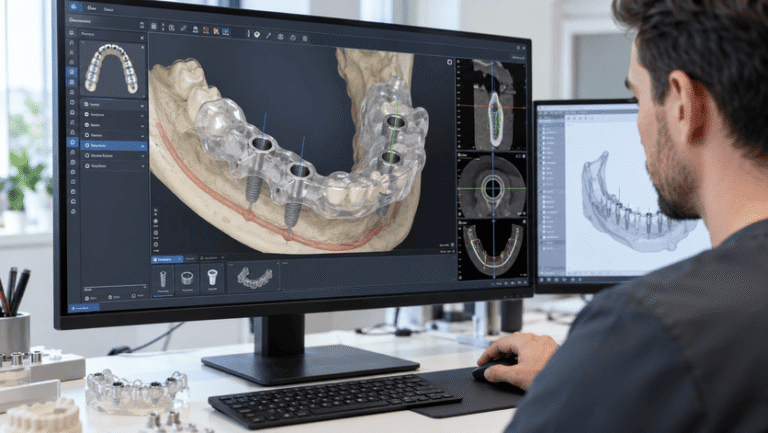
digital-crown-bridge-workflow-accuracy
Standard Fabrication and Delivery Schedule
All timelines below reflect digital workflow submissions (STL, OBJ, or PLY via 3Shape, Exocad, or iTero). Physical model cases add 3 to 4 days for inbound shipping.
| Restoration Type | In-Lab Time | Transit (UPS/DHL/FedEx) | Door-to-Door |
|---|---|---|---|
| Zirconia Crown / Bridge | 3–4 days | 2–3 days | 5–7 days |
| e.max / Full Ceramic | 3–4 days | 2–3 days | 5–7 days |
| Layered Zirconia / PFZ | 3–4 days | 2–3 days | 5–7 days |
| PFM | 3–4 days | 2–3 days | 5–7 days |
| Full Metal Crown | 3–4 days | 2–3 days | 5–7 days |
| Composite Restoration | 3–4 days | 2–3 days | 5–7 days |
| All-on-X Bridge / Bar / Abutment | 4–6 days | 2–3 days | 6–9 days |
| Implant Framework (Ti / Co-Cr / PEEK) | 3–4 days | 2–3 days | 5–7 days |
| Full Denture | 3–4 days | 2–3 days | 5–7 days |
| Acrylic / Flexible Partial | 3–4 days | 2–3 days | 5–7 days |
| Nightguard / Splint | 3–4 days | 2–3 days | 5–7 days |
| Orthodontic Appliances | 4–6 days | 2–3 days | 6–9 days |
| CAD Digital Design Only | 12–18 hours | N/A | 12–18 hours |
Rush service is available across all restoration types. Contact the team for case-specific scheduling.
Regional Transit Reference
Transit times are consistent across major markets when shipped via Tier-1 carriers:
- North America & Asia: 2 business days (3 days for remote areas)
- Europe & Australia: 3 business days (4 days for remote areas)
- South America & Middle East: 2 to 4 business days depending on regional hub routing
- Remote areas: One additional transit day plus applicable surcharges
Shipping Cost Structure
- Under 20 cases per shipment: Freight is billed to the clinic
- 20 or more cases per shipment: Raytops covers full shipping cost
- New partners: Free trial cases are available before committing to volume — the most direct way to verify fabrication standards before scaling
The 20-case threshold is the point at which overseas fabrication economics shift decisively. Below that number, freight eats into a meaningful portion of the per-unit cost advantage. At or above 20 cases per shipment, the per-unit cost differential versus domestic lab pricing becomes financially significant.
Speed matters. But total delivery value is the metric that determines whether a dental lab relationship works at scale:
Dental Lab Value = Chairside Time Saved + Logistics Speed + Unit Price + Total Shipping Cost
That means evaluating in-lab time, transit reliability, unit price, and shipping cost together — not in isolation.
How Overseas Lab Turnaround Compares to Domestic Options
For practices currently using domestic labs — or evaluating how overseas fabrication fits into an existing workflow — the relevant comparison is total door-to-door time, not in-lab time alone.
digital-dental-lab-zirconia-bridge-design
What the Numbers Actually Look Like
Domestic labs like Dandy and Glidewell typically quote 3 to 5 business days for crown and bridge cases. That window reflects in-lab fabrication time. It does not account for the pickup-to-delivery cycle most practices actually experience — local courier pickup, inbound transit to the lab, and return shipping back to the clinic.
When total cycle time is measured door-to-door, the gap between domestic and overseas fabrication narrows considerably:
| Workflow | In-Lab Time | Total Door-to-Door |
|---|---|---|
| Domestic lab (physical model) | 3–5 days | 5–9 days |
| Overseas lab (physical model) | 3–4 days | 8–12 days |
| Overseas lab (digital submission) | 3–4 days | 5–7 days |
| Overseas lab (digital + pre-cleared) | 3–4 days | 5–6 days |
The comparison that matters for scheduling decisions is the digital overseas workflow versus the total domestic cycle — not the in-lab benchmarks quoted on either side.
Where the Real Difference Shows Up
Total cycle time is one variable. The others are unit cost, remake frequency, and volume scalability.
Domestic labs carry higher per-unit pricing and fixed capacity constraints. For a single-location practice running 10 to 15 cases per month, domestic fabrication is often the simpler operational choice. For DSOs, high-volume practices, or labs managing multi-location case flow, the economics of overseas fabrication — even accounting for international shipping — shift the cost structure materially.
The question is not which model is universally better. It is which model fits the volume, workflow, and margin structure of a specific practice.
How a Below-2% Remake Rate Protects Your Practice Schedule
Quoted turnaround time is only half the picture. The variable most practices don’t account for when evaluating a lab is remake frequency — and it’s the one that causes the most damage to patient scheduling.
A case that requires a remake doesn’t just add one fabrication cycle. It adds return shipping, re-fabrication time, and outbound shipping again. A 4-day production window becomes a 12 to 14 day total delay. One remake per month, across a practice running 30 overseas cases, translates to 10 to 14 days of unrecoverable scheduling disruption every cycle.
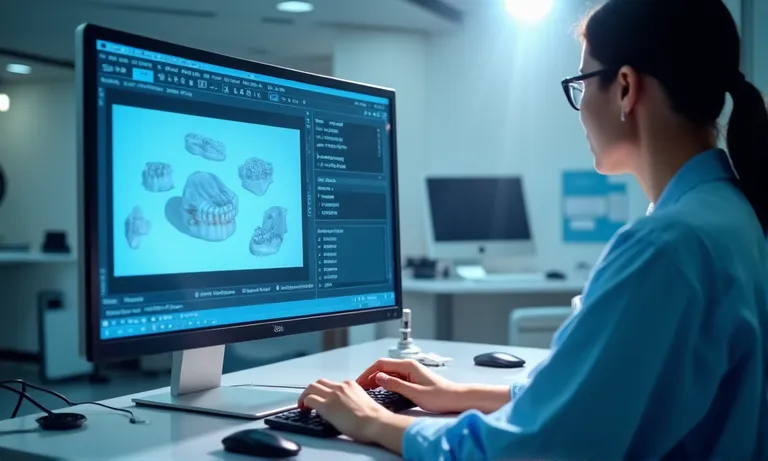
A sub-2% remake rate is the output of a six-stage production flow where quality checks are built into fabrication — not bolted on at the end.
dental-cad-integration-scanner-file-import
The 6-Stage Production Flow
1. Intake Pre-Check Every incoming file — STL or physical model — goes through a pre-check before entering the fabrication queue. Unclear margins, missing Rx details, or ambiguous occlusal references are flagged immediately. Cases with incomplete data are held, and the submitting clinic is contacted within the same business day. Nothing enters fabrication with unresolved questions.
2. Case Assignment Cases are not simply queued in order of arrival. Each restoration type is routed to a specialized technician team. Complex implant cases, full-arch reconstructions, and aesthetic anterior work are handled by the teams built specifically for those categories. This parallel routing prevents high-complexity cases from creating bottlenecks in standard fabrication flow.
3. Standardized Fabrication Protocols Every restoration follows a documented step-by-step fabrication standard. For zirconia-based restorations, sintering curves are non-negotiable — the 8 to 12 hour controlled cooling cycle for complex All-on-X bridges exists because compressing that window introduces micro-fracture risk that won’t surface until the restoration is under occlusal load. Speed at that stage is the wrong optimization.
4. In-Process Quality Checks Quality control is not a final gate. Checks are built into multiple points during fabrication — after milling, after sintering, after layering where applicable. Correcting a small detail during production takes minutes. Catching the same issue at final inspection costs a full remake cycle. Fix it early so it never affects final delivery.
5. Rapid Internal Communication When a technical question surfaces during fabrication — an ambiguous contact point, a shade confirmation, a framework fit concern — the CAD design team, fabrication technician, and customer service contact resolve it within the same production shift. A question that sits unanswered for 24 hours becomes a production delay. This loop is closed the same day, every time.
6. Final Inspection Before Shipment Before any case is packed, it undergoes a master technician review: margin fit under magnification, occlusion check on articulated models, contact tightness verification. The standard applied at this stage is whether the restoration is seat-ready without adjustment. Cases that don’t pass are remade internally — which is why the rate stays below 2% rather than being pushed downstream to the practice.
What a Sub-2% Remake Rate Actually Means for Scheduling
A practice running 20 overseas cases per month at a 2% remake rate will statistically encounter fewer than one remake every two months. At a 10% remake rate — which is not uncommon in lower-cost overseas labs — that same practice is managing 2 to 3 remakes per month, each carrying a 10 to 14 day resolution cycle.
The difference is not aesthetic. It’s operational. Predictable fabrication quality is what allows a practice to schedule patient seating appointments with confidence before the case has even shipped.
Two Key Factors That Speed Up Turnaround Time Further
Two workflow changes can reduce total cycle time without adding fabrication risk. The first is digital file submission. The second is pre-clearance logistics. Neither requires significant operational change on the clinic side. Both have a measurable impact on total door-to-door time.
dental-lab-margin-validation-quality-check
Digital File Submission: Eliminating the Inbound Shipping Window
Physical impressions or stone models require 3 to 4 days of inbound transit before fabrication can begin. That window adds nothing to restoration quality — it’s pure waiting time.
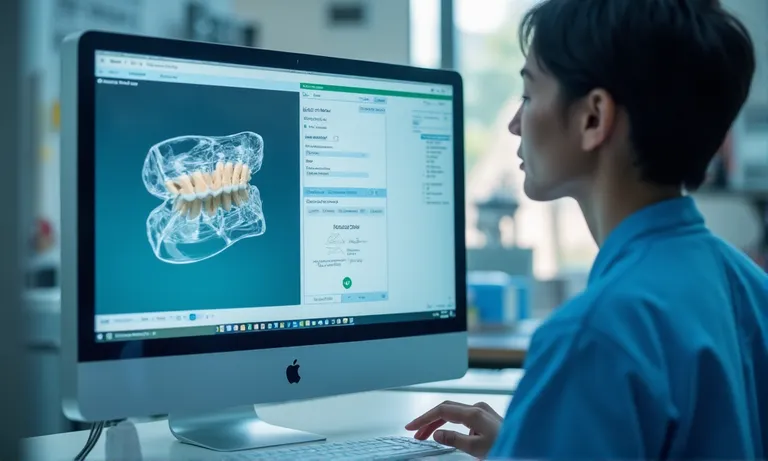
Raytops accepts STL, PLY, or OBJ files directly from 3Shape Communicate, Exocad, and iTero. Once a file reaches the server:
- Automated digital pre-check within 2 hours: File integrity, margin visibility, and Rx completeness are verified before the case enters the CAD design queue
- Same-day design start for files received before the daily cutoff: Cases don’t sit overnight waiting for a technician to open them the next morning
- Elimination of impression-related variables: No stone model expansion, no tray distortion, no shipping damage to physical models — marginal integrity and seating accuracy improve as a direct result
Switching to digital submission doesn’t change what the lab delivers. It removes 3 to 4 days from the front end of every case cycle.
Pre-Clearance Logistics: Removing the Customs Delay Variable
International shipments that go through standard customs processing on arrival typically add 1 to 2 unpredictable days to transit time. Pre-clearance documentation changes that.
By filing customs documentation before the package departs — coordinated through established carrier agreements with FedEx, DHL, and UPS — customs review runs in parallel with the flight, not after it. The package clears before it lands, eliminating the post-arrival queue that standard processing requires.
Pre-clearance is Raytops’ standard logistics protocol, not a premium tier. Every shipment is filed before departure — compressing what would otherwise be a variable 1 to 3 day customs window into a consistent 24 to 36 hours after landing for North American destinations.
The practical effect: front desk scheduling operates on confirmed arrival dates, not estimated windows. Patient seating appointments can be booked before the case ships.
Combining Both: What the Numbers Look Like
| Submission Method | Inbound | Fabrication | Transit | Total |
|---|---|---|---|---|
| Physical model (standard logistics) | 3–4 days | 3–4 days | 2–3 days | 8–11 days |
| Digital STL (standard logistics) | 0 days | 3–4 days | 2–3 days | 5–7 days |
| Digital STL (pre-cleared logistics) | 0 days | 3–4 days | 2 days | 5–6 days |
The shift from physical to digital submission, combined with pre-clearance logistics, removes 3 to 4 days from total cycle time — without changing fabrication standards or compressing any stage of production.
Conclusion: Turnaround Time Is a System, Not a Promise
A 5 to 7 day door-to-door window is achievable consistently — but only when fabrication discipline, quality control, and logistics execution operate as a single coordinated system rather than three separate variables.
The practices that get the most value from dental lab partnerships are not necessarily the ones chasing the fastest quoted turnaround. They are the ones working with a lab where remake rates are low enough to schedule patient appointments with confidence, where digital submissions are processed without friction, and where every case ships with pre-clearance documentation already filed.
The free trial case program is the most direct way to verify whether the communication, CAD design, and fabrication standards described here hold in practice — before committing to volume. [Send your first trial case today]