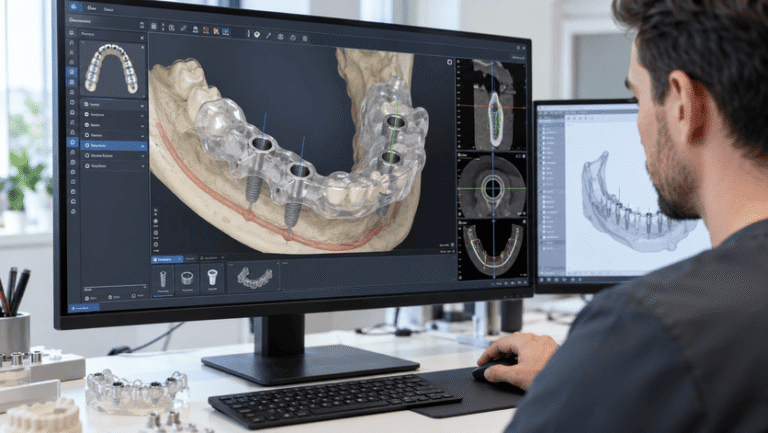
Improving surgical guide accuracy requires more than a better scan, a well-designed guide, or a more precise fabrication process. Accuracy is built progressively from implant planning to clinical placement.
A sound implant target must first be established, then preserved through reliable digital data and registration, stable guide support and seating, controlled drill guidance, faithful fabrication, and final clinical verification. Different cases may place more stress on different parts of this chain, but the principle is the same: improve accuracy by strengthening every step that carries the planned implant position forward.
Systematic reviews of static guided implant surgery have consistently found measurable differences between virtually planned and clinically placed implant positions, with deviation arising across planning, laboratory, and surgical phases rather than from a single step.
Start With the Right Implant Target
Improving surgical guide accuracy should start before guide design or fabrication. The first requirement is a clinically and restoratively sound implant target. Anatomy, restorative requirements, prosthetic space, and the intended final restoration all help define the implant position that the guide will later try to reproduce.
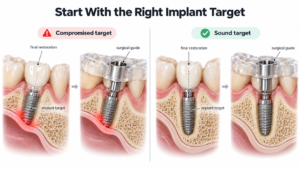
Define the Implant Position Before Trying to Reproduce It Accurately
A surgical guide transfers a planned implant position; it does not decide whether that position is appropriate. If the target is compromised from the beginning, a highly accurate guide may simply reproduce the wrong target more consistently.
For this reason, the intended implant position should be established from both anatomical and restorative requirements before attention shifts to guide fit, sleeve geometry, printing accuracy, or other downstream controls. Those later steps can improve how faithfully the plan is transferred, but they cannot correct the planning objective itself.
Keep Planning Quality Separate From Transfer Accuracy
Planning quality and execution accuracy are related, but they are not the same problem. A sound implant plan can still be transferred poorly if registration, guide stability, drill guidance, fabrication, or seating introduces deviation. The reverse is also true: an accurately seated and well-fabricated guide can faithfully reproduce a plan that was not ideal to begin with.
That distinction keeps accuracy improvement in the right order. First confirm that the implant target is sound; then improve how accurately that target is carried through the rest of the workflow.
Build Accuracy on Reliable Digital Data and Registration
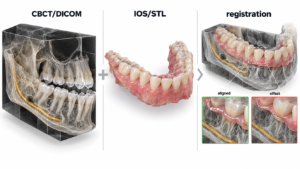
Once the implant target is defined, the next priority is making sure the digital model represents that target reliably. CBCT/DICOM and IOS or surface-scan data provide the anatomical and surface information used for planning and guide design. If those datasets are incomplete, unreliable, or incorrectly registered, the positional error can be carried into every downstream step.
Improve the Quality of the Input Data
Good planning cannot compensate for poor digital input. CBCT/DICOM should provide usable anatomical information, while IOS, STL, or other surface-scan data should capture the relevant teeth and soft-tissue geometry completely enough for the intended workflow.
The goal is not simply to collect more files. It is to make sure the files being used actually provide a reliable digital representation for planning, registration, and guide design.
Verify CBCT–IOS Registration Before Moving Downstream
Registration is one of the most important accuracy checkpoints because it defines the spatial relationship between the CBCT and surface data. If that relationship contains an offset, the virtual anatomy used for planning is already displaced. The implant plan and guide design may then be internally consistent while still being based on the wrong spatial relationship.
Registration studies have shown that CBCT-to-surface alignment can be affected by data preprocessing, operator variation, and the presence of restorations, and that registration error is transferred into the surgical field.
In our review, registration problems are not always obvious from the merged 3D view alone. When the relationship around key dental landmarks appears inconsistent, checking cross-sectional views before guide design can reveal a mismatch that might otherwise be carried into the rest of the workflow.
Registration should therefore be verified before guide design continues. When CBCT, IOS, or merged datasets do not agree reliably, downstream optimization should pause; improving sleeve position, guide support, or fabrication accuracy cannot compensate for an unconfirmed digital relationship. Once registration is reliable, the next accuracy controls—support, seating, stability, and guidance—have a sound foundation to build on.
Improve Guide Support, Seating, and Functional Stability
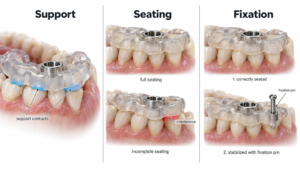
Once the digital foundation is reliable, accuracy depends on whether the guide can seat correctly and remain stable during use. Tooth-supported, mucosa-supported, and bone-supported guides create different mechanical conditions, but the support label alone does not determine accuracy. What matters is how the guide is actually supported, how that support is distributed, and whether the guide remains stable under functional load.
Look Beyond Support Type to Support Geometry
Two guides with the same support type can behave very differently. Support distribution, unsupported spans, distal extensions, contact area, and lever arms all influence how easily the guide can rock, flex, or shift.
Experimental and clinical research also shows that guide accuracy can vary with the number and distribution of supporting teeth, with distal-extension and reduced-support conditions creating more demanding stability conditions.
That is why support geometry is usually more useful than the support label itself. A tooth-supported guide, for example, may still become unstable if the support is poorly distributed or if a long unsupported extension creates leverage. The design should therefore aim to create a support pattern that resists movement in the directions that matter during the procedure, rather than assuming the support category alone guarantees stability.
Separate Fit, Seating, Retention, and Stability
These terms are related, but they describe different things.
A guide may appear to fit while still not being fully seated. It may also have good retention while remaining vulnerable to movement under drilling forces. As our experiences, retention can sometimes create false confidence. A guide may feel secure while a local interference or insertion-path conflict prevents it from reaching its intended position completely. Stability only exists when the guide reaches the intended position and can maintain that position during use.
This distinction matters because each problem needs a different correction. Poor fit may require checking the digital model or internal geometry. Incomplete seating may come from insertion-path interference or local contact. Weak retention may require better engagement with the supporting anatomy, while functional instability may require changes in support distribution, rigidity, or fixation. Accuracy should therefore not be judged from “fit” alone; the guide must reach its intended position and remain stable under the conditions in which it will actually be used.
Use Rigidity and Fixation to Support Stability, Not to Hide Poor Seating
Rigidity and fixation can improve stability, especially when support is limited or the guide is exposed to greater movement risk. But fixation should reinforce a correctly seated guide, not compensate for a guide that has not reached its intended position.
A fixation pin can stabilize the guide only after the guide is seated correctly. If the guide is displaced first, fixation may simply lock the error in place.
Research on fixation has also shown that fixation pins may improve selected deviation measures, but they do not provide a universal accuracy advantage across all conditions.
The same principle applies to rigidity: increasing material thickness or reinforcement can reduce flex, but it cannot correct incorrect seating or poor support geometry.
The right sequence is therefore to establish reliable support, confirm full seating, provide enough rigidity for the case, and then add fixation when the mechanical conditions require it.
Control Both Guidance Precision and Guidance Coverage
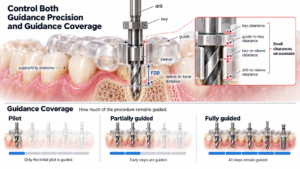
Once the guide is seated and stable, another source of deviation remains: the drill can still move within the guidance system. Guide stability controls the relationship between the guide and the patient; guidance precision controls the relationship between the drill and the guide. These are two different mechanical problems.
Reduce Mechanical Play Within the Guidance System
The drill is rarely controlled by a single component. Depending on the system, guidance may involve several interfaces:
- Drill to key
- Key to sleeve
- Sleeve to guide
- Guide to the supporting anatomy
Small clearances at these interfaces can accumulate. Free drilling distance and sleeve-to-bone distance also affect how much unsupported movement can occur between the guide and the osteotomy site.
Studies summarized in the guided-surgery literature suggest that reducing free drilling distance and positioning the guiding interface closer to the osteotomy site can improve mechanical control, although the practical limit still depends on access and the guided system being used.
In some cases we have handled, the implant trajectory itself was not the limiting factor. The practical constraint was whether the selected sleeve, drill, or key could actually follow that trajectory within the available vertical or interproximal space.
The goal is therefore not simply to choose a “precise sleeve,” but to reduce unnecessary mechanical freedom across the whole guidance chain.
This is also why sleeved and sleeveless systems should not be treated as automatic winners or losers. Removing an interface may reduce one source of tolerance accumulation, but current comparative evidence does not support a universal conclusion that sleeveless guidance is more accurate than sleeved guidance across all systems and clinical conditions. The complete system and case conditions still matter.
Match the Level of Guidance to the Accuracy Control Needed
Guidance precision and guidance level describe different aspects of control.
| Guidance Precision | Guidance Level | |
|---|---|---|
| Main question | How tightly is the instrument controlled during a guided step? | How much of the procedure remains mechanically guided? |
| Typical variables | Drill–key–sleeve tolerance, FDD, sleeve geometry | Pilot, partially guided, fully guided protocol |
| Accuracy role | Reduces mechanical freedom within a controlled stage | Determines how long the planned trajectory remains mechanically constrained |
| Main risk | Excess play within the guidance system | Losing mechanical control during later procedural stages |
A pilot guide may control the initial osteotomy while later steps rely more on clinical execution, whereas a fully guided protocol extends mechanical control further through the procedure. The difference is therefore not simply “less accurate” versus “more accurate”; it is how much of the planned trajectory remains mechanically constrained.
More guidance, however, is not automatically better. Fully guided, sleeveless, milled, flexible, or other design approaches should not be treated as universal accuracy winners. The available evidence does not support that kind of blanket conclusion. In one case, the limiting factor may be tolerance within the guidance system or the amount of guided control; in another, registration, support, seating, or fabrication may remain the weaker link.
The goal is not maximum guidance in every case, but enough reliable guidance to preserve the planned implant position through the stages where mechanical control matters most.
Preserve Accuracy Through Fabrication and Physical QC
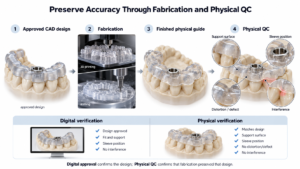
An accurate digital design still has to survive fabrication. Once the approved CAD file becomes a physical guide, dimensional change, material behavior, manufacturing defects, or interface errors can reduce the accuracy already established during planning and design.
The goal of fabrication is therefore not simply to produce a usable guide. It is to reproduce the approved design closely enough that the intended support, seating, sleeve position, and guidance geometry are preserved in the physical device.
Preserve the Approved Design During Fabrication
Whether the guide is 3D printed or milled, fabrication introduces another accuracy-control stage. Machine calibration, material behavior, processing, and post-processing can all affect the final dimensions of the guide.
The important question is not which fabrication method is universally “more accurate.” Some studies have reported higher dimensional accuracy for milled guides, while others found no significant difference in the final implant placement accuracy achieved with additive versus subtractive guides. The more useful target is therefore fabrication fidelity—whether the chosen process reproduces the approved design reliably under the conditions of that workflow.
Approved CAD geometry → physical guide with the same critical positional relationships
If those relationships change during manufacturing, the digital design may have been correct while the physical guide is not.
Verify the Physical Guide, Not Just the CAD File
Digital approval confirms the design. It does not confirm the finished guide.
Physical QC should therefore check the features that can directly affect positional transfer, such as:
- dimensional distortion or obvious manufacturing defects;
- incomplete or damaged support surfaces;
- sleeve or guide-hole position and integrity;
- interference that may prevent full seating;
- defects introduced during post-processing or assembly.
The purpose is not to inspect every surface equally. QC should focus on features that could change how the guide seats, stabilizes, or controls the instrument.
A useful distinction is:
| Digital Verification | Physical Verification |
|---|---|
| Is the approved design correct? | Was that design reproduced correctly? |
| Checks planning and CAD geometry | Checks the manufactured guide |
| Happens before fabrication | Happens after fabrication |
| Cannot detect manufacturing defects | Confirms whether fabrication preserved the intended geometry |
This is why Digital approval ≠ Physical guide verification. The approved file is the target; the finished guide still has to prove that it matches that target.
Once fabrication fidelity is confirmed, one final accuracy checkpoint remains: whether the physical guide actually seats correctly in the clinical environment.
In a multi-team workflow, each accuracy checkpoint also needs a clear owner. Registration may be reviewed during planning, support and guidance geometry during design, fabrication fidelity after manufacturing, and final seating clinically. When one stage is outsourced, responsibility for checking that stage should either move with the task or be explicitly handed back to the next owner.
Verify Seating Before the Plan Reaches Clinical Execution
A surgical guide can match the approved CAD design and still fail to reproduce the planned implant position if it does not seat correctly intraorally. This is the last transfer point before guided drilling, where digital fidelity and fabrication fidelity must become clinical fidelity.
Physical Accuracy Does Not Guarantee Correct Clinical Seating
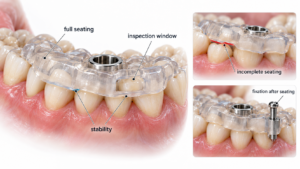
Physical QC confirms that the guide was fabricated as intended. Clinical seating confirms something different: that the guide has actually reached its intended position on the patient.
Incomplete seating may come from local interference, tissue conditions, insertion-path limitations, debris, or other case-specific factors. Even a small seating discrepancy can change the relationship between the guide, sleeve or guide hole, and the planned implant trajectory.
That is why the final guide should not be judged only by whether it “fits.” The relevant question is whether it is fully seated in the intended position and behaves as expected under the conditions in which it will be used.
Confirm Full Seating and Stability Before Guided Drilling
Before guided drilling begins, the guide should be checked for the conditions that directly affect positional transfer:
- Full seating — the guide has reached the intended position without visible or tactile interference.
- Seating verification — available windows, landmarks, or support contacts confirm that the position is correct.
- Stability — the guide does not rock or shift under the expected functional load.
- Fixation — when used, fixation stabilizes the confirmed position rather than compensating for incomplete seating.
This final check protects everything established earlier in the workflow. A sound implant target, accurate registration, stable support, controlled drill guidance, and faithful fabrication only matter if the guide reaches the same intended position clinically.
The full accuracy-building chain therefore ends where the guide meets the patient:
Set the right target → build it on reliable data → stabilize the guide → control drill guidance → preserve the design through fabrication → verify the final clinical seating.
The relative importance of each control changes with the case, but the principle stays the same: accuracy improves when every stage preserves the positional control created by the stage before it.
Conclusion: Improve the Weakest Link Without Losing Accuracy Elsewhere
Surgical guide accuracy is not created by one component or one step. It depends on whether the planned implant position is defined correctly, represented reliably in the digital workflow, mechanically supported and guided, preserved through fabrication, and finally verified in the patient.
The priority will not be the same in every case. One case may be most sensitive to registration, another to support geometry or seating, and another to drill guidance or fabrication. The practical approach is to identify where positional control is most vulnerable, strengthen that stage, and make sure the improvement is not lost further downstream.
The best accuracy strategy is not to maximize every variable, but to protect the planned implant position through every stage from planning to placement.
If a current surgical guide case is difficult to assess, it can be useful to review the full chain rather than keep adjusting one design parameter at a time. Raytops can look at the available case data and help identify where the main uncertainty is entering the workflow before deciding what actually needs to change.