Surgical Guide Workflow: Planning, Design, and Fabrication — In-House vs Outsourced
By Mark Guo
October 4, 2026
14 min read
A surgical guide workflow does not have to be entirely in-house or entirely outsourced. Planning, design, and fabrication are different capabilities, and each can be kept internal, outsourced, or shared in a hybrid model.
Planning depends heavily on clinical and restorative context and decision authority. Design depends on specialized judgment, capacity, iteration, and communication. Fabrication depends more on equipment, a validated process, post-processing, utilization, and physical QC.
The real decision is therefore not simply “in-house or outsourced?” It is where each capability should sit, what control must remain internal, and how the stages should connect without adding unnecessary cost, handoff risk, or management burden.
Source the Surgical Guide Workflow by Stage, Not as One Block
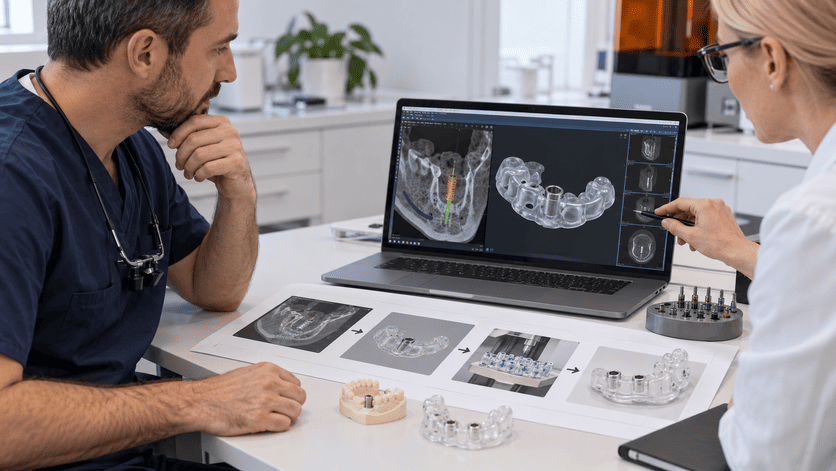
Planning, design, and fabrication are connected, but they require different capabilities and do not need the same ownership. A clinic or dental lab may keep planning and approval internal, outsource guide design, and fabricate locally. Another organization may keep planning and design in-house while outsourcing fabrication.
The sourcing decision should therefore be made stage by stage, not for the entire workflow at once.
Surgical guide workflow showing planning, design, and fabrication as separate stages that can be managed in-house or outsourced
Planning, Design, and Fabrication Are Different Capabilities
Owning a 3D printer does not mean owning the full surgical guide capability. Likewise, having planning software does not mean every planning decision should move outside the clinic, and having CAD software does not automatically create a sustainable design function.
In workflows we have handled, the need for external support is often much narrower than “outsource the surgical guide workflow.” Planning and final approval may already be well established internally, while design is the actual capacity gap; in other cases, fabrication is already mature locally and only planning or design support is needed.
That is why three questions should be asked for every stage:
Capability — What expertise, people, equipment, process, and QA does this stage require?
Ownership — Should that capability be internal, external, or shared?
Connection — If ownership changes, how will context, approval, files, and responsibility pass to the next stage?
A stage may be technically possible to perform internally and still be expensive to maintain in skilled time, management attention, or fixed resources. Outsourcing may remove that burden, but only when the handoff itself does not create a new one.
The right operating model is the one that places each capability where it can be performed reliably while keeping the overall workflow easier—not harder—to manage.
Surgical Guide Planning: Who Should Own the Decision?
Planning is the stage most dependent on clinical and restorative context. The key sourcing question is therefore not where the planning file is created, but who owns the clinical decision and final approval.
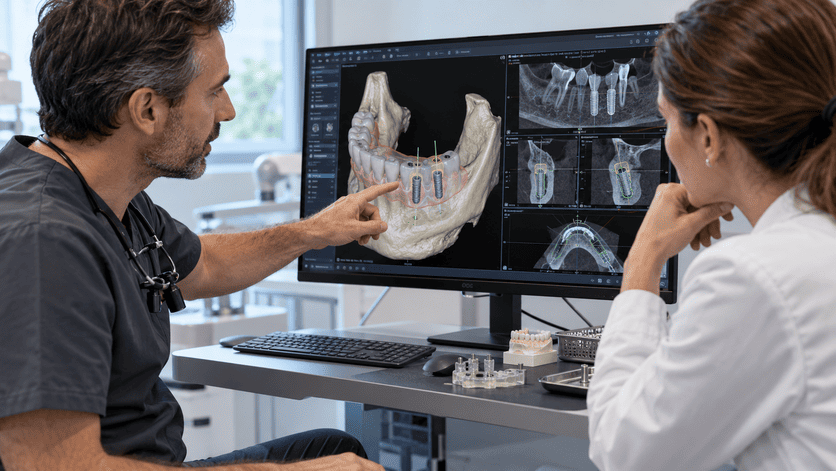
Dental CAD designer creating a surgical guide with implant positions, guide sleeves, and supporting anatomy
External technical support can assist with planning without transferring clinical decision authority.
Clinical Decision Authority Matters More Than File Location
A planning workflow should make four responsibilities clear:
Who defines the clinical and restorative objective?
Who provides and interprets the necessary case context?
Who can make technical planning recommendations?
Who gives final clinical approval?
Execution ownership and decision authority do not have to sit in the same place.
A clinic can retain the treatment objective and final approval while an external team provides technical planning support, prepares the case, or carries out requested revisions. What matters is that the approval boundary remains explicit.
Separate a Capacity Gap From a Capability Gap
Not every planning problem requires the same sourcing response.
Capacity Gap
Capability Gap
Problem
The team can do the work but lacks time or availability
The case requires expertise or experience that is not reliably available internally
Typical need
Additional planning capacity
Specialized planning support
Likely response
External support during workload peaks
External expertise for selected case types
A temporary workload peak does not automatically justify transferring planning ownership. Likewise, available internal time does not solve a genuine capability gap.
For many organizations, the more practical model is shared planning:
Internal: clinical objective, restorative intent, final approval External: technical planning support, preparation, revision Shared: clarification and review when a decision requires clinical input
The planning question is therefore not “inside or outside?” It is:
Which work can be executed externally while the decisions that must remain clinical stay under internal authority?
Surgical Guide Design: Where Should Specialized Design Capability Sit?
Surgical guide design is often the easiest stage to underestimate. Buying software creates access to a tool; it does not automatically create a reliable design capability.
A sustainable internal design function also depends on designer skill, case exposure, availability, revision experience, backup capacity, and the ability to preserve the approved planning intent through design.
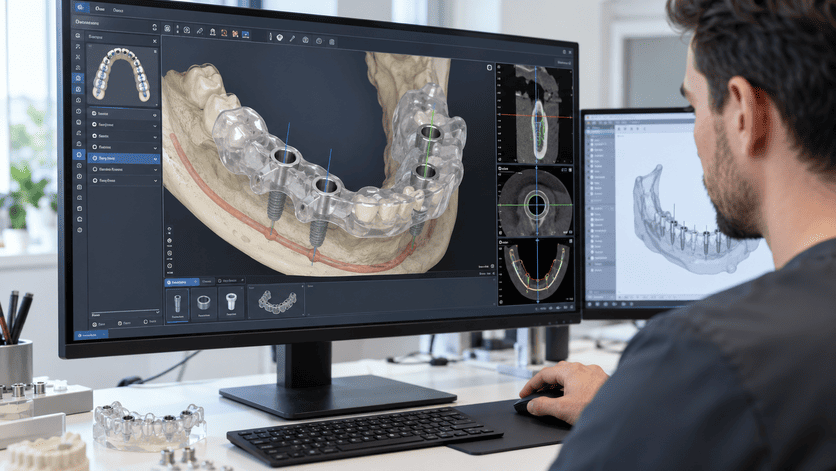
Dental CAD designer working on a surgical guide with implant positions, guide sleeves, and supporting anatomy
In-House Design Requires More Than Software Access
The useful question is not:
Do we have the software?
It is:
Do we have sustainable surgical guide design capability?
If the function depends on one person, irregular availability, or constant senior review, it may be technically in-house but operationally fragile.
A recurring pattern in external design workflows is that the client already knows how to design surgical guides. The actual problem appears when routine volume and complex cases compete for the same limited senior design capacity. In that situation, outsourcing is not replacing an absent skill; it is protecting internal capacity from becoming the bottleneck.
Outsourcing Design Can Solve Different Problems
Situation
What Is Missing
Typical Sourcing Logic
Volume peak
Designer time
Add flexible external capacity
Senior designer bottleneck
Experienced execution/review capacity
Use specialist external support
Rare or complex cases
Case-specific expertise
Outsource selected cases
No stable internal design team
Sustainable specialist capability
Use external design as an ongoing operating model
Planning and fabrication already internal
Only the design stage
Outsource design without changing the rest of the workflow
This is why “outsource design” is not one business model. It can be temporary capacity, selective specialist support, or a permanent stage inside an otherwise internal workflow.
Case complexity can also change the answer. Full-arch, stackable, or other complex workflows can increase planning dependency, revision consequence, coordination requirements, and QA burden. A clinic or lab may therefore use one ownership model for routine cases and another for complex cases.
If planning and fabrication are already established internally, Raytops can support the surgical guide design stage without requiring the rest of the workflow to move outside. The final design can return to the existing approval and fabrication process rather than replacing it.
The better question is not whether design should always be in-house or outsourced. It is whether the required design capability is available internally at the right level of skill, capacity, consistency, and management cost for the actual case mix.
Surgical Guide Fabrication: When Does In-House Fabrication Make Sense?
Fabrication is often reduced to a simple equipment question:
Do we have a 3D printer?
But printer ownership is only one part of the capability.
Reliable in-house fabrication also requires a validated process, material handling, post-processing, physical QC, trained staff, maintenance, failure recovery, and enough capacity to keep the workflow running consistently.
Transparent surgical guides being 3D printed in a dental laboratory as part of an in-house fabrication workflow
Owning a Printer Is Not the Same as Owning a Fabrication Capability
A sustainable fabrication function may include:
validated printing or milling workflow;
controlled material handling and post-processing;
dimensional and physical QC;
trained staff;
maintenance and failure recovery;
backup capacity for routine and peak volume.
This is why “we already own the printer” is not a complete make-or-buy argument.
The relevant question is:
Can the complete fabrication process be operated reliably enough that internal ownership creates more value than operational burden?
Utilization Changes the Economics
In-house fabrication places more cost into fixed capability. Outsourcing converts more of that requirement into variable access.
In-House Fabrication
Outsourced Fabrication
Equipment and software investment
Per-case external cost
Staff and training
Less internal fabrication labor
Maintenance and backup capacity
Supplier dependency
Post-processing and QC ownership
External handoff and delivery
Economics improve with utilization
Cost remains more variable with volume
Utilization matters because equipment, staff, software, QA, and backup resources become easier to justify when they are used consistently. Low or irregular volume can leave capability underused; stable higher volume can make internal ownership more attractive.
There is no useful universal case-count threshold for every clinic or laboratory. The relevant break-even point depends on the actual combination of capital, skilled labor, utilization, failure/rework, maintenance, QC, and management cost.
Local Fabrication Only Improves Turnaround When Fabrication Is the Bottleneck
Printing locally can shorten the fabrication leg. It does not automatically shorten the whole surgical guide workflow.
If most delay comes from planning, design, clinical approval, revisions, or case clarification, moving printing in-house may have little effect on total turnaround.
Local fabrication creates the most value when fabrication is actually a meaningful constraint and the organization already has a reliable process to absorb it.
In-House vs Outsourced Surgical Guides: Compare Total Operating Burden, Not Per-Guide Price
Per-guide price is an easy number to compare, but it is rarely the whole make-or-buy decision.
The real comparison is between two operating models:
What resources must be owned internally, and what workload remains after the external service is added?
Comparison of in-house and outsourced surgical guide workflows based on equipment, utilization, operating cost, and management burden
Fixed Cost vs Variable Cost Is Only the First Layer
A useful comparison should include more than equipment price or design fee.
Decision Area
In-House Question
Outsourced Question
Skilled attention
How much clinician or senior designer time does the stage consume?
How much internal review and clarification is still required?
Utilization
Is the capability used enough to justify fixed resources?
Does variable external cost remain efficient as volume grows?
Failure / rework
Who absorbs failed work and repeat effort?
How are external corrections and revisions handled?
Management burden
How much supervision is required internally?
Does the provider actually reduce coordination work?
Capacity flexibility
Can the internal team absorb peaks without bottlenecks?
Can external capacity expand without adding fixed headcount?
Continuity
What happens when a key employee or machine is unavailable?
Is the external workflow stable enough to become dependable capacity?
This is where a low per-case price can become misleading.
Forty-five minutes of printer run time is not the same resource as forty-five minutes of senior clinician or designer attention. Machine time may be largely autonomous; skilled human time consumes capacity that could be used for clinical work, planning, review, or higher-value design decisions.
Likewise, an inexpensive outsourced service may still be costly if each case requires repeated explanations, avoidable corrections, or continuous internal supervision.
The cheapest guide is not necessarily produced by the workflow with the lowest total operating cost.
Break-Even Is Not the Same as Operational Readiness
Even when case volume appears high enough to justify internal ownership, the workflow may not yet be ready to internalize.
Operational readiness also requires:
reliable skill and staffing;
documented process and QC;
revision handling;
backup capacity;
clear responsibility;
sufficient experience with non-routine cases.
A financial calculation answers whether ownership may make economic sense.
It does not answer whether the organization can run the stage reliably.
Economic viability and operational readiness are two separate decisions. Internalize a stage only when both are strong enough to support it.
Hybrid Surgical Guide Workflow: Keep Control Across the Handoffs
For many clinics and laboratories, the most practical answer is neither all in-house nor all outsourced.
A hybrid workflow places each stage where the required capability can be managed best while keeping clinical context, approval, files, and responsibility clear between owners.
The main risk is not that work crosses an organizational boundary. The risk is that context or decision authority becomes unclear when it does.
Hybrid surgical guide workflow with internal clinical control and external support for selected design or fabrication stages
Handoff Risk Depends on What Is Being Handed Off
Stage
What Mainly Crosses the Handoff
Main Risk
Planning
Clinical/restorative intent, judgment, case context
Planning is more difficult to separate cleanly because it depends heavily on clinical and restorative context. Fabrication is generally easier to define because its input and output can be specified and physically verified. Design sits between them: the geometry is technical, but the designer still needs enough context to preserve the approved intent.
The cleanest hybrid workflows we have worked with are not necessarily those with the fewest handoffs. They are the ones where each handoff makes four things clear:
What has been approved?
What is being delivered?
What still needs review?
Who owns the next decision?
Control Can Be Preserved Without Owning Every Execution Step
Common hybrid models include:
external planning support + internal clinical approval;
external surgical guide design + internal planning approval and fabrication;
internal planning/design + external fabrication.
These models separate process execution from decision control.
An external team can perform a defined capability while the clinic or laboratory retains the decisions that must remain under its authority.
This is especially important for organizations that already have a mature digital workflow. Outsourcing does not need to replace what already works. It should fill the stage where specialist skill, flexible capacity, or operating efficiency is actually missing.
Choose the Ownership Mix, Not the Ideology
The final model should follow:
required capability;
case volume and variability;
case complexity;
skilled internal capacity;
utilization;
turnaround bottlenecks;
management burden;
control requirements;
handoff risk.
All In-House works when planning, design, and fabrication capabilities are already sustainable internally.
All Outsourced can make sense when specialized capability is not worth internalizing or variable access is preferable to fixed capacity.
Stage-Level Hybrid works when different stages are better placed with different owners.
Neither model is automatically better.
The better surgical guide workflow is the ownership combination that provides the required capability while keeping decision authority, responsibility, handoff, and management effort under control.
Conclusion: Choose the Ownership Mix That Fits the Workflow
The best surgical guide workflow is not automatically all in-house, all outsourced, or hybrid.
Planning, design, and fabrication should each sit where the required capability can be managed most reliably and efficiently. That decision should reflect clinical control, specialized skill, case volume, utilization, skilled human capacity, workflow complexity, turnaround bottlenecks, operational readiness, management burden, and handoff risk—not simply equipment ownership or per-guide price.
The most useful final rule is:
Decide capability ownership stage by stage, then design the handoffs so decision authority, responsibility, and workflow efficiency remain clear.
When planning and clinical approval are best retained internally but specialized design capability is better accessed externally, that is not a loss of control. It is a deliberately designed operating model.
If the right ownership mix is still unclear, start with one representative case and the workflow already in place. Raytops can review where planning, design, approval, and fabrication currently sit, then help determine whether the real need is additional capacity, specialist design support, or a clearer handoff—not automatically move the entire workflow outside.
3D printing is redefining dental implant lab workflows by combining speed, precision, and digital integration. From rapid prototyping to patient-specific…